The Taxi Problem

I’ve been thinking this for a while, but Uber integrating coach and train travel in their app is what convinced me to finally write an article on it. A transition to green infrastructure is essential. They’ll probably happen, but electric cars for everyone are the wrong way to go about it given the problems we already face with car dominated infrastructure. To get the best future, we need trains, and to get good trains, we need a solution to the “first mile, last mile” problem.

The first mile, last mile problem (or FMLM problem as I’ll call it from now) is the problem of the inescapable reality of public transport never taking you to your door. A well-connected train station in your local area is realistic, and the map of the UK’s railways before the Beeching cuts prove it, but there will always be people living in neighbourhoods without a train station. Buses can help fix this problem and it certainly isn’t fantasy thinking that everybody should live within 5 minutes of a bus stop, but they might not always be on the right route, and they present an extra challenge and delay for reducing emissions and car domination. That challenge is worth overcoming, but it’ll take time. Here is the FMLM problem – you can do the middle 200 miles of your journey by train with relative ease, but if the first and last miles are by foot, it is significantly harder and less appealing.

In the short-medium term, before we get these fantastic bus networks and huge railway expansion (if we ever get them) that shrink the first and last miles down to a few hundred metres, we need to address the FMLM problem by other means. In big cities, rental e-scooters try to do this, but whilst they solve some problems they also leave huge gaps. The users of these e-scooters is disproportionately young, white and male, there’s the issue of how they interact with pedestrians and cars, and disabled people and people with luggage can’t use them. I’m sure there’s an awful lot that I haven’t covered, too.

This means we are left with a system where, if we want the public transport system to be a fully functioning network that’s accessible to people, we need to embrace taxis. These allow people to take greater advantage of the railways even in bad weather or with luggage. They make travel more accessible for disabled people. They facilitate earlier and later travel, both by beating the bus timetables and by letting people feel safer than walking through city streets at midnight. But, unfortunately, they’re also a poorly regulated industry where safety violations are commonplace and discrimination is impossible to prove.

Let me talk about my own experiences, for a moment. A couple of months ago I was trying to get home after a night out from Birmingham’s gay village. I wasn’t particularly drunk, and the people I was with were at least coherent and not about to vomit. There we were, stood on the corner of a street in Birmingham, vulnerable. I took the photo at the top of this article. In the process of waiting for a taxi, we had two separate cars drive up to us and have their occupants shout “batty boys”; the passenger in one car filmed it. This didn’t fill me with confidence with regards to getting into a stranger’s car.

On top of this, there’s the issue of how difficult it is to even get a taxi from the gay village. Uber and Bolt drivers accept, then see you’re in the gay village, and reject it. This rejection is the best outcome, too – if somebody’s too uncomfortable to pick me up from the queer bit of town, I’m probably not safe in their car. Accessing this crucial bit of infrastructure can be emotionally challenging for any sober person, let alone somebody in a vulnerable state. Even without this discrimination, taxis can be hard to access, with taxi ranks placed far away from the clubbing areas.

Then there are the conditions in a cab. A driver wearing their seatbelt, not using their phone, and not vaping is the exception to what I am used to. I don’t want to have somebody’s vape in my face, but passengers are often not in a position to request the driver stops doing something in their car. The same goes if I feel unsafe with their driving – what are my options, especially given they have my home address? This power imbalance and lack of oversight leads to some significant issues for passenger comfort and safety, undermining trust in taxis.

These five things – vulnerability, unreliability, discrimination, difficulty of access, and power imbalance with no oversight – all combine into what I consider the taxi problem. This is the exclusion of some vital infrastructure from public thought and/or policymaking priorities due to it not being seen as vital and/or infrastructure, leading to issues including but not limited to access, safety, and quality. These themselves can lead to a reluctance to engage in the systems they include, with people being less likely to want to use public transport for a journey. The FMLM problem therefore isn’t resolved despite the technology existing for it, because the systems which FMLM transport relies on suffer from the taxi problem.

Whilst these five aspects are specific to taxis, the broader concept of the exclusion of infrastructure from public thought leading to poor outcomes and engagement is by no means exclusive to the area of transport. It can be applied to pharmacies for example, where there is little NHS oversight and poor quality results can undermine confidence in the healthcare system as a whole. Regardless of the service it is being applied to, it is a concept worthy of more exploration as it is, as we speak, limiting the future potential for adapting systems due to undermining public confidence.

Without addressing the taxi problem by, amongst other things, increasing standards, reducing discrimination, and introducing proper oversight, we will struggle to move into a future where public transport can be relied on. We will continue to have high A&E and GP waiting times as pharmacies and walk in centres aren’t relied on and preventative care doesn’t meet its full potential. We will have public services where things that should have been resolved sooner weren’t due to limited thinking around what critical infrastructure is, leading to a much bigger combination of social costs and tax burdens in the future.

The taxi problem is the biggest challenge we face precisely because nobody is talking about it. When the taxi problem enters mainstream dialogue, it will likely cease to be a problem at all.
Instagram activism is hypocritical and lacks nuance. Why?

As a quick disclaimer, this post deals with some pretty sensitive topics. Whilst I’ve done my best to approach them with care, please bear in mind that it obviously isn’t my intention to offend or blame anyone as you read on.

At the height of anti-police protests last summer, my Instagram feed was filled with people very honourably and justifiably calling for the police to be defunded. The big issue on every university student’s mind was – rightly – the killing of Sarah Everard. Even for me, a white able-bodied man, it was impossible to escape the reality of the fear that women felt. A serving police officer had killed a woman. At the time I posted on Instagram highlighting the lack of “good” cops in the Met. Why shouldn’t women and men be calling for the defunding of the police as an institution when its officers have killed women and criminalised vigil?

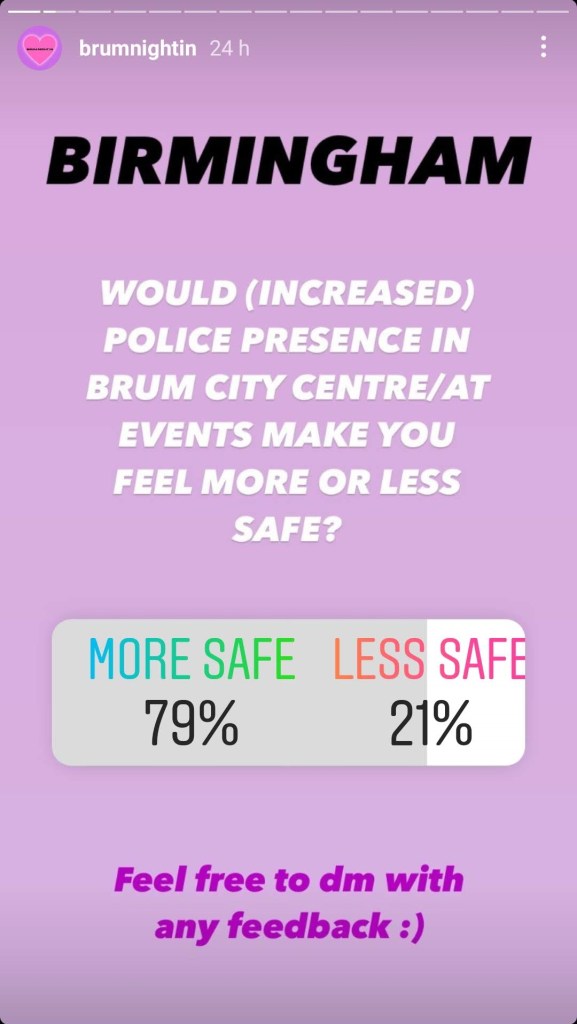
Fast forward to the return to universities this year. For my year group, it’s the first time clubs have been open when we’re at uni, and for the year below (and anyone born after March in my year group) it’s the first time they’ve been open since they turned 18. The issue on everyone’s mind is no longer Sarah Everard, but rather the fact that people – predominantly women – are being spiked by injection at an insane rate. A couple of weeks ago it was impossible to scroll through my Instagram stories without seeing another innocent person be spiked with a needle. A student group was set up at my university, on Instagram @brumnightin – calling for a boycott of clubs that don’t do enough to keep women safe. A couple of weeks ago, they posted a poll on their Instagram story – and these were the results.

The student population of Birmingham were, once again very rightly, saying that an increased police presence would make them feel safer. It would make me feel safer, so these students can’t be blamed.

That said, suddenly a student population that had appeared to overwhelmingly support defunding the police in summer had switched to wanting more police that winter. This is the embodiment of Instagram activism – a phenomenon significant enough that a fair few people will be familiar with the term already. I don’t seek to blame anyone here – I was the same: wanting to get rid of an institution that has, bluntly, shown no respect for women’s rights, and wanting women to feel safer in clubs. There’s no easy solution to this; the way I see it, people called for the right thing twice, but the two things they called for are incompatible with each other. So the question is, why does this happen?

As a geography student who has previously studied sociology, I’m acutely aware of how spaces are designed to make us interact with them in certain ways, and I think this can be applied to social media to figure out why Instagram activism, in particular, is so toxic. My belief as to why arose during a conversation with my wonderful mentor, Aisling, as to why I thought Twitter was so toxic – there’s so many arguments. Despite the flaws of these arguments (and believe me, there’s a fair few), they provide opposing viewpoints. I came to understand that part of the reason Twitter has so many confrontations is because of the way the platform is designed – click on a tweet and the option to reply is front and centre, you can’t delete the comments on your tweets, and the platform centres short text-based exchanges.

Instagram is quite the opposite. The replies are out of the way, you can delete and disable comments, and the platform is based on images. The general idea is you see an image and you like it or you move on, and the user interface runs with that idea. There’s nothing encouraging you to reply, and nothing really encouraging you to read the replies. Even the phrasing – “Tweet your reply” versus “Add a comment” makes Twitter encourage conversation and Instagram indifferent about it. Sure, the conversations on Twitter aren’t necessarily the most pleasant, but at least they’re there. I even had them forced upon me because I tweeted about fonts.

This is where the bandwagon nature of Instagram activism comes in. If you see a broadly agreeable Instagram post or story, you don’t go out of your way to scrutinise it or disagree with it because you’re simply not encouraged to. You either like it or move on, and when so many people are liking it, it’s extremely easy to get swept up with the dominant view at the time. At the peak of an event, story after story can be filled with well-intentioned friends sharing ill-researched posts. An example that comes to mind is a post on the Israel-Palestine conflict that was widely shared last summer and included the following:

“They are not ‘fighting’, Israelis are the oppressors and Palestinians are the oppresseed and the situation is about anything but religion.”

@key48return on Instagram

This was, quite clearly, a sweeping generalisation about every Israeli citizen based on the actions of the Israeli government. It ignores the complex history of the region and the fear that many Israelis face in the name of standing up for the oppressed. It is one thing to say the Palestinian people are oppressed, but it is a different matter completely when you say every Israeli is the oppressor. Yet proud anti-racists shared it far and wide because they saw it as standing up for an oppressed group. And, to me at least, it seems this happened because of Instagram’s aversion to dialogue. You don’t come away from the post with a balanced view, because you don’t see a conversation – all you see is an infographic taking up half of the screen, with “Liked by someone you know and 300,000 others”.

So how can we fix this? Well, Instagram can fix it, at least partially, by offering more room for dialogue given that the platform is becoming an increasingly political platform which inevitably leads to it becoming a bigger echo chamber for at least some users. They probably won’t fix it though, given that the app has been based around big images with just a bit of text since its creation. That leaves the burden on Instagram users to be more willing to criticise infographics when they’re one-sided. Look at the account of a post before you share it – what’s the bias? It also needs to be understood that complex issues, whether it’s the police, race relations, or international conflicts, can’t be reduced down to a simple 10 slide Instagram graphic, and nor should they be. Issues like this need time, depth and nuance, and when they are discussed on social media they need dialogue at the very least.

This post was in part inspired by a Vox documentary on how colour schemes on Instagram have been used to make infographics look progressive when they are the opposite. You can watch it on their YouTube channel here.