Perhaps fringe politics is the wrong word, acknowledging that Reform held a comfortable lead in public opinion polls for over a year until Starmer resigned, and the Greens have, at times in the last year, overtaken Labour. But there is no doubt that Reform are further right than the Conservatives, and the Greens further left than Labour. Both were once fringe parties, reflecting in their small number of MPs. And both are populists – something which I don’t like.
It is no surprise that my last two posts have been positive about Andy Burnham. He shares my politics almost exactly. I would describe us both as ambitious but pragmatic social democrats. I am sure Andy Burnham could make a compelling case for the abolition of tuition fees. I am also sure that he understands that it shouldn’t be priority number one in times of economic uncertainty. He is pro-city and pro-devolution. That’s where I land. Andy Burnham just has vastly superior experience and communication skills than me.
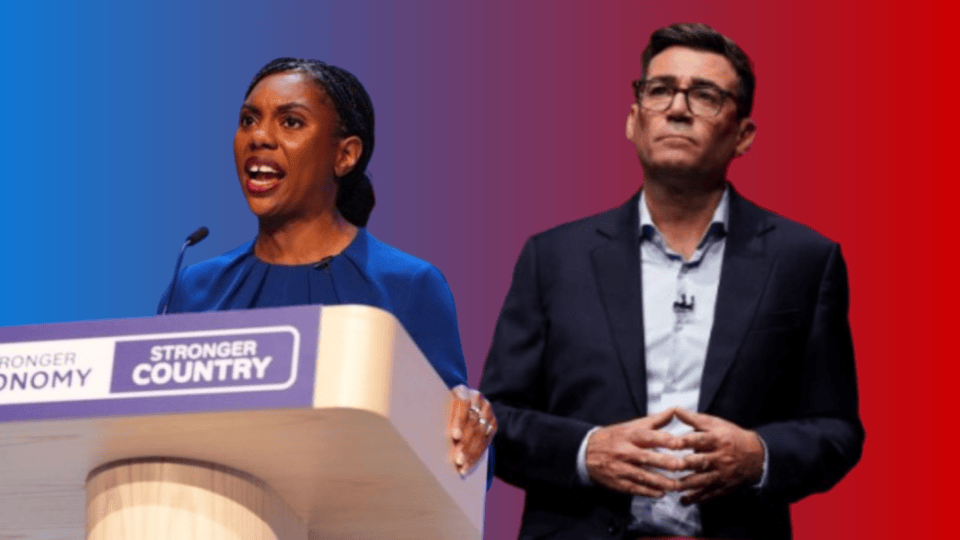
What I am more reluctant in admitting, but nonetheless fear I have to, is that Kemi Badenoch appears to have found her stride. She is morally coherent – if disagreeable – and appears to enjoy her job. She has momentum in the Tory Party, and has taken policy positions popular with its members. She is a good, and improving, public speaker. And she, with Andy Burnham’s help, is increasingly making a cut-through argument as to how the Conservatives will govern differently to Labour. I make no secret of the fact I would never vote Conservative, but I also hope to make no secret of the fact I will at least try to be objective.
There are real arguments now, between Labour and Conservatives, about the size of the state. They were always there, but perhaps less visible and for the wrong reasons. Conservatives have always been for a smaller state, but austerity was argued as from a place of necessity rather than an objectively better way to govern (and paired with, ahem, the triple lock). Boris Johnson’s levelling up agenda was, however you frame it, about wealth distribution. And the 2024 Conservative manifesto was a battle of damage reduction and getting out the core voter base with policies like the quadruple lock and national service rather than a legitimate ideological vision.
This led to the left and the right both seeing different versions of one reality. On the left you have commonplace language such as Red Tories amongst Green supporters, with people disappointed that Keir Starmer didn’t go far enough to distance himself from the Conservative Party. On the right, Reform push the language of the uniparty, trying to make voters believe that there are no legitimate differences between the parties. For a while, this worked.
Now a perfect storm is brewing which is bringing people back to the old red/blue politics for better or for worse. It’s not entirely reflected in the polls yet – and so I do hope my speculation proves correct – but whisper it quietly, I think it will. There is more charisma and divide between Labour and Conservatives, yes. But there is also something else.
The Greens’ conference appears to have been a disaster and for many swing voters, the more they see of Zack Polanski the less they like him. I am certainly in that category, given he is a self-proclaimed populist, and I don’t much care for populists. Its conference was divisive at times with most Green MPs (and Zack Polanski) opposing the “Zionism is racism” motion which was passed by its members, rejecting an internationally- and Palestinian-supported two-state solution. It was uglier at other times, with members rejecting safeguards against disciplining party members for affiliation with Jewish institutions which identify as Zionist.
Left-wing journalist Owen Jones tweeted a phrase which wouldn’t have looked out of place from Rupert Lowe:
There is nothing racist about any ethnic or religious group wanting their own homeland.
He does go on to say that “Zionism in practice meant ‘a homeland at the expense of the Palestinians’,” and that this was why Zionism is racism. Without getting into an in depth essay on Palestinian liberation, this exposes the rifts forming on the left, and the arguments which are perhaps morally murky at times . It also exposes where party democracy can become over-democracy, with members attempting to decide a leader’s policy for them. My interest in the constitution always leads me to believe that a party must decide what is sovereign, and where policy comes from, and seek to not have formal party mechanisms which fundamentally undermine this. In well-established parties, I believe sovereignty should lie with MPs, and democracy should be exercised by members through MPs rather than in spiteof them. This is why Corbyn’s leadership was a disaster regardless of where you sit politically: sovereign MPs being overwritten by party members creates an ungovernable mess. The Greens are at risk of this and it may turn ugly.
Tomorrow is the Holborn and St Pancras by-election. Zack Polanski is on the ballot. It is a liberal, London constituency. It is the seat of the most unpopular Prime Minister in living memory. If Zack Polanski fails to win it, it will be difficult to spin, and it could well spark the end of his charismatic leadership and fresh divides in the Green Party. People do buy into Polanski’s populism – that is why it’s called populism – and it remains to be seen whether another leader could have the same galvanising effect.
On the other side of the aisle chasm, Reform are slowly but surely slipping in the polls. There was once a time – see their repeated success in the polls below – where they looked sure to be the dominant party in votes, even if not in seats, come the next general election. Their messaging was slick, their campaigning was dirty, and they captured people’s anger. The public were shifting to the populist right based on their frustration with the cost of living, immigration, and the undefined woke liberal elite. It was easy to see that people were frustrated with the Conservative and Labour governments and so the natural place for them to go if they leant right was Reform. This was always going to happen – the Conservatives’ record in government was high tax, poor services, not enough prison spaces, and a poor delivery record. To many people, Labour was unappealing and more of the same disappointment.
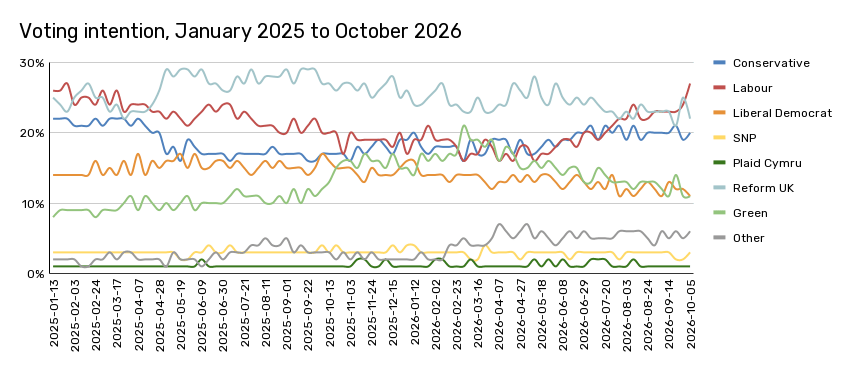
As time has gone on, however, Reform have got dirtier and dirtier. Their image is no longer of that of political outsiders but rather dirty money. They have underperformed in recent by-elections, and their record where they are in power in local government will do them a disservice. As with all populists, they are successful until they have to keep their promises; one Reform council in the north of England has recently received criticism for shutting nurseries. Each promise they have been given a chance to keep has gone poorly. How is finding waste in councils going, Mr Farage?
This dirtying of their image, combined with an obvious change in both the Labour and Conservative parties, might just mean Reform too has peaked. The improving communication of both parties mean that there is now a clearly left wing government and a clearly right wing opposition. The right may be returning to the Conservatives just as the left return to Labour. Kemi Badenoch may have been correct this week when she said a battle of ideas is coming.