When Ruth Bader Ginsburg died just 6 weeks before the 2020 Presidential Election, Mitch McConnell was keen to have the Senate confirm one of Trump’s Supreme Court nominees before it took place. This is despite the fact that McConnell himself was very clear in 2016 that the Senate would not hear any of Obama’s nominations for the Supreme Court justice to follow Scalia an entire 9 months before the 2016 Presidential Election.
For those of you who don’t know, the Supreme Court is made up of nine justices to uphold the Constitution of the United States. Those justices serve life terms, and they’re replaced when they resign or pass away. A President will nominate a justice to fill a vacant seat, and the Senate will vote to confirm that justice. This process has become politicised, with Presidents appointing justices who will fit their agenda – Republican Presidents will appoint justices that take a pro-life interpretation of the Constitution, for example, whilst Democrats will appoint justices more likely to uphold Roe vs Wade (the ruling which legalised abortion nationwide).
This politicisation of the Supreme Court has, for the most part, been played quite nicely between the two sides. If the Senate sees a qualified candidate, it will generally appoint. However, this precedent was resigned to history in 2016 when the Senate Majority Leader Mitch McConnell said that the Senate would not even hear the case for an Obama appointed justice – nothing would happen until the new President, whether Clinton or Trump, was inaugurated. Fast forwards four years to a Trump administration, and McConnell was eager to backtrack on his precedent and appoint a justice before a Presidential election. With the disregarding of one precedent, another was set: one of ignoring good faith and past precedent. Whatever the GOP (another name for Republicans) say in one case, it’s not for the sake of the nation, Constitution, or good faith, but rather for the sake of furthering their own agenda. Will they force through a poor quality nomination to strengthen the conservative majority on the Supreme Court? Absolutely.
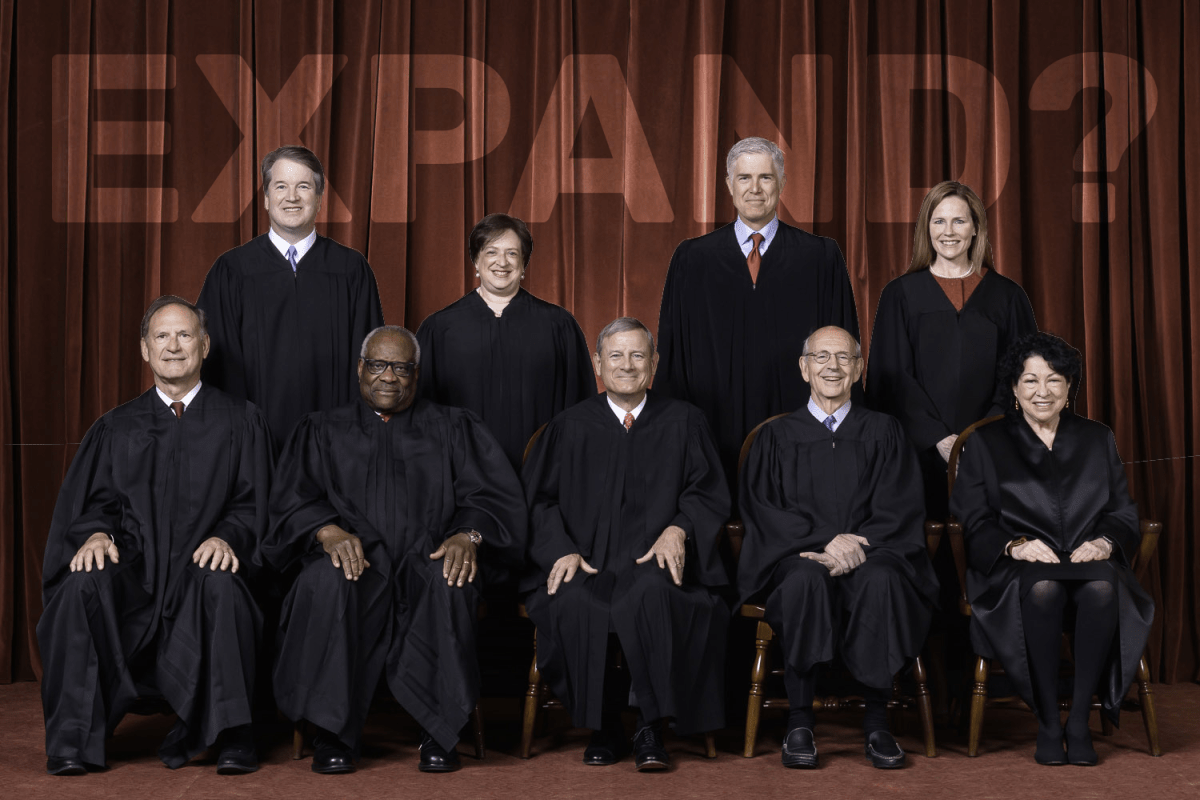
With the Republicans brazenly playing dirty, Biden should have done the same. The letter of the Constitution applies, of course, but not the spirit. Anything the Democrats restrict themselves from doing now will only be done by the GOP further down the line, unless it’s constitutionally disallowed. That leaves two options for ideological success: do something first, or make sure it never happens. And so comes forth the idea of court expansion, which we’ll return to later. The court is made up of 9 judges, and past precedent has kept it this way. Obama only nominated when 9 became 8, and Trump did the same. However, there’s no rule that says this has to be the case. The exact words of the Constitution with regards to the Supreme Court are as follows:
“…he shall nominate, and by and with the advice and consent of the Senate, shall appoint ambassadors, other public ministers and consuls, judges of the Supreme Court, and all other officers of the United States, whose appointments are not herein otherwise provided for, and which shall be established by law: but the Congress may by law vest the appointment of such inferior officers, as they think proper, in the President alone, in the courts of law, or in the heads of departments.”
In plain English, this reads along the lines of “The President can nominate Supreme Court justices with the permission of the Senate [amongst others]: but Congress may put legal limits [age, criminal background, etc.] on who can take up these roles.” There’s absolutely no mention of an upper limit of justices. I could talk about the many pros and cons of a Constitution in the formate of America’s, but this is one of its flaws: it’s taken literally and incredibly hard to change. No mention of an upper limit? Then there’s no upper limit until 3/4 of States, 2/3 of the House and 2/3 of the Senate agree.
So where is – or was – Biden’s opportunity for Constitutional change? When discussion of court expansion came up in the campaigns and debates for the 2020 election, Republicans were opposed – or at least the voters were. If Biden could get the Democrat members of the House and Senate on board, which he probably could given the GOP’s history of doing everything they can to sabotage the Democrats, he can then say to Republicans: here’s your chance to stop me from expanding the court. And it could well be electoral suicide for many Republicans to say no, given Biden’s unpopularity with their voters.
The Republicans have already proven they’ll play dirty – if there’s nothing Constitutional preventing them from doing something, the chances are they’ll do it. This means that, if a 2024 Trump Presidency happens, the court may well be expanded with conservative justices if no safeguards are put in place to prevent this. The controversy has died down now, meaning Biden has less fuel to ignite Constitutional change, and the Republicans have their eyes firmly set on returning to the White House. If they can do this, they could well take full control of the Presidency, House, Senate, and (in effect) the Supreme Court. It may be too late now, but Biden’s refusal to rule it out in the 2020 election means that the GOP can get away with it with little legitimate criticism from Democrats, and politicising a judiciary is never a good idea.
Hopefully this opportunity isn’t missed, and hopefully Biden realises that the best thing for America is to rule out Supreme Court expansion in order to keep it as nonpartisan, or at least bipartisan, as possible. However, I have a feeling that neither of those things will be true: court expansion is an issue at the back of voters’ minds if there at all, and Biden doesn’t seem to want to rule it out, leaving an open door for Trump to give America its most conservative court ever.
 Lewis Compton