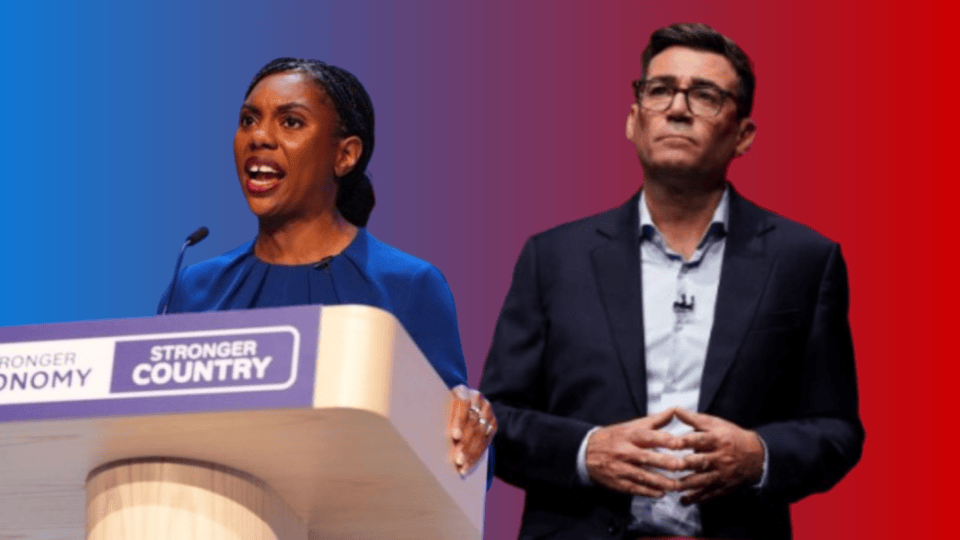
Stop the small votes: the end of fringe and populist politics?

Perhaps fringe politics is the wrong word, acknowledging that Reform held a comfortable lead in public opinion polls for over a year until Starmer resigned, and the Greens have, at times in the last year, overtaken Labour. But there is no doubt that Reform are further right than the Conservatives, and the Greens further left than Labour. Both were once fringe parties, reflecting in their small number of MPs. And both are populists – something which I don’t like.

It is no surprise that my last two posts have been positive about Andy Burnham. He shares my politics almost exactly. I would describe us both as ambitious but pragmatic social democrats. I am sure Andy Burnham could make a compelling case for the abolition of tuition fees. I am also sure that he understands that it shouldn’t be priority number one in times of economic uncertainty. He is pro-city and pro-devolution. That’s where I land. Andy Burnham just has vastly superior experience and communication skills than me.

What I am more reluctant in admitting, but nonetheless fear I have to, is that Kemi Badenoch appears to have found her stride. She is morally coherent – if disagreeable – and appears to enjoy her job. She has momentum in the Tory Party, and has taken policy positions popular with its members. She is a good, and improving, public speaker. And she, with Andy Burnham’s help, is increasingly making a cut-through argument as to how the Conservatives will govern differently to Labour. I make no secret of the fact I would never vote Conservative, but I also hope to make no secret of the fact I will at least try to be objective.

There are real arguments now, between Labour and Conservatives, about the size of the state. They were always there, but perhaps less visible and for the wrong reasons. Conservatives have always been for a smaller state, but austerity was argued as from a place of necessity rather than an objectively better way to govern (and paired with, ahem, the triple lock). Boris Johnson’s levelling up agenda was, however you frame it, about wealth distribution. And the 2024 Conservative manifesto was a battle of damage reduction and getting out the core voter base with policies like the quadruple lock and national service rather than a legitimate ideological vision.

This led to the left and the right both seeing different versions of one reality. On the left you have commonplace language such as Red Tories amongst Green supporters, with people disappointed that Keir Starmer didn’t go far enough to distance himself from the Conservative Party. On the right, Reform push the language of the uniparty, trying to make voters believe that there are no legitimate differences between the parties. For a while, this worked.

Now a perfect storm is brewing which is bringing people back to the old red/blue politics for better or for worse. It’s not entirely reflected in the polls yet – and so I do hope my speculation proves correct – but whisper it quietly, I think it will. There is more charisma and divide between Labour and Conservatives, yes. But there is also something else.

The Greens’ conference appears to have been a disaster and for many swing voters, the more they see of Zack Polanski the less they like him. I am certainly in that category, given he is a self-proclaimed populist, and I don’t much care for populists. Its conference was divisive at times with most Green MPs (and Zack Polanski) opposing the “Zionism is racism” motion which was passed by its members, rejecting an internationally- and Palestinian-supported two-state solution. It was uglier at other times, with members rejecting safeguards against disciplining party members for affiliation with Jewish institutions which identify as Zionist.

Left-wing journalist Owen Jones tweeted a phrase which wouldn’t have looked out of place from Rupert Lowe:

There is nothing racist about any ethnic or religious group wanting their own homeland.

He does go on to say that “Zionism in practice meant ‘a homeland at the expense of the Palestinians’,” and that this was why Zionism is racism. Without getting into an in depth essay on Palestinian liberation, this exposes the rifts forming on the left, and the arguments which are perhaps morally murky at times . It also exposes where party democracy can become over-democracy, with members attempting to decide a leader’s policy for them. My interest in the constitution always leads me to believe that a party must decide what is sovereign, and where policy comes from, and seek to not have formal party mechanisms which fundamentally undermine this. In well-established parties, I believe sovereignty should lie with MPs, and democracy should be exercised by members through MPs rather than in spiteof them. This is why Corbyn’s leadership was a disaster regardless of where you sit politically: sovereign MPs being overwritten by party members creates an ungovernable mess. The Greens are at risk of this and it may turn ugly.

Tomorrow is the Holborn and St Pancras by-election. Zack Polanski is on the ballot. It is a liberal, London constituency. It is the seat of the most unpopular Prime Minister in living memory. If Zack Polanski fails to win it, it will be difficult to spin, and it could well spark the end of his charismatic leadership and fresh divides in the Green Party. People do buy into Polanski’s populism – that is why it’s called populism – and it remains to be seen whether another leader could have the same galvanising effect.

On the other side of the aisle chasm, Reform are slowly but surely slipping in the polls. There was once a time – see their repeated success in the polls below – where they looked sure to be the dominant party in votes, even if not in seats, come the next general election. Their messaging was slick, their campaigning was dirty, and they captured people’s anger. The public were shifting to the populist right based on their frustration with the cost of living, immigration, and the undefined woke liberal elite. It was easy to see that people were frustrated with the Conservative and Labour governments and so the natural place for them to go if they leant right was Reform. This was always going to happen – the Conservatives’ record in government was high tax, poor services, not enough prison spaces, and a poor delivery record. To many people, Labour was unappealing and more of the same disappointment.
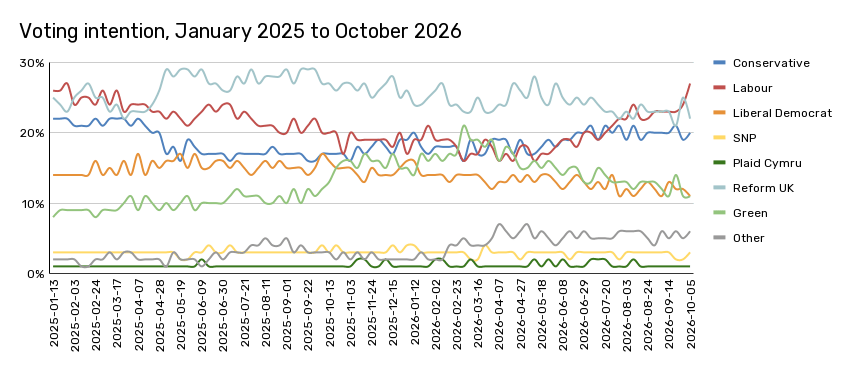
As time has gone on, however, Reform have got dirtier and dirtier. Their image is no longer of that of political outsiders but rather dirty money. They have underperformed in recent by-elections, and their record where they are in power in local government will do them a disservice. As with all populists, they are successful until they have to keep their promises; one Reform council in the north of England has recently received criticism for shutting nurseries. Each promise they have been given a chance to keep has gone poorly. How is finding waste in councils going, Mr Farage?

This dirtying of their image, combined with an obvious change in both the Labour and Conservative parties, might just mean Reform too has peaked. The improving communication of both parties mean that there is now a clearly left wing government and a clearly right wing opposition. The right may be returning to the Conservatives just as the left return to Labour. Kemi Badenoch may have been correct this week when she said a battle of ideas is coming.
Is Andy Burnham Britain’s Mark Carney?

Andy Burnham and Mark Carney share a number of similarities as political heavyweights and recently selected Prime Ministers. Will Burnham’s success follow Carney’s?

Andy Burnham and Mark Carney share a number of similarities as political heavyweights and recently selected Prime Ministers. Both became leader of their parties with overwhelming support and little serious opposition. Neither were longstanding Members of Parliament when elected Prime Minister. Both became leader of left wing governing parties, replacing a deeply unpopular leader. Neither was forecast to perform well at the next election.

Both are good listeners to the extent of disapproving of their Parliamentary party’s own legislation, acting in an almost Presidential fashion. Upon his election, Mark Carney nullified the Liberal government’s previous carbon tax, said yes to new fossil fuel development, and campaigned to address immigration. Upon his election, Andy Burnham removed VAT on electricity bills, has promised to be “pragamtic” on new fossil fuel development, and campaigned to address small boat crossings.

In Canada, the Liberal Party was trailing in the polls until a couple of things became clear. One, there was a change of direction at the top, and a leader who was in touch with the public. Two, foreign policy had a unifying effect on Canadians against a foreign opponent (remarkably, in the United States). Andy Burnham has secured the former, and the latter may come into play with rising tensions in Argentina, increasing threats from Russia, and wider geopolitical recalibration. A “rally round the flag” effect present challenging circumstances for a Prime Minister and few would like to be in that position, but the effect on their polling is undoubtable. Just look at Boris Johnson’s polling during the COVID pandemic.

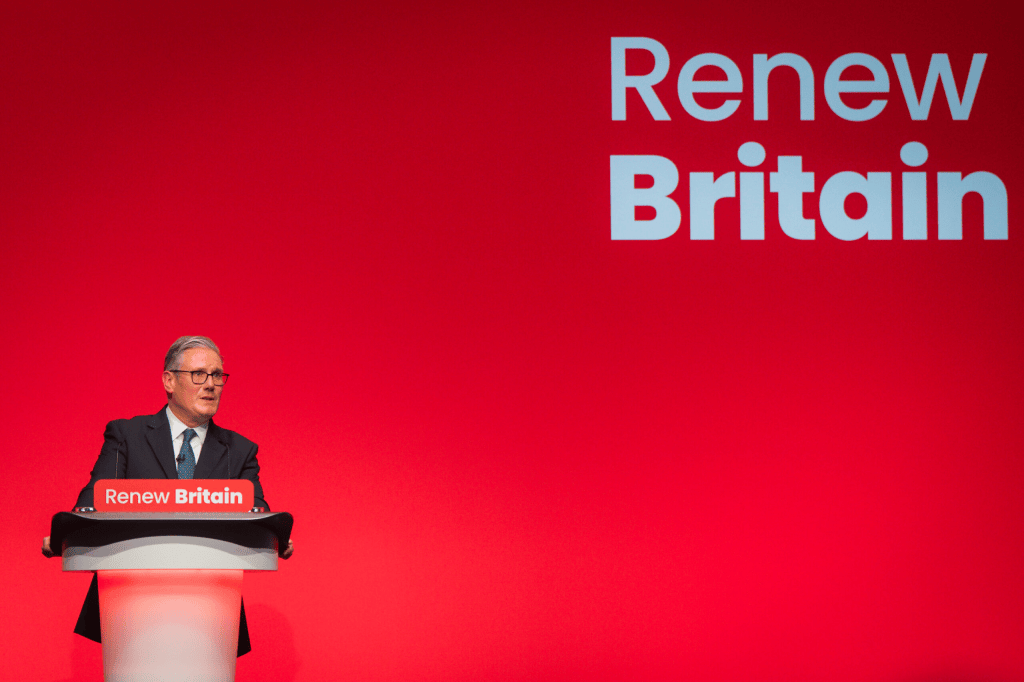
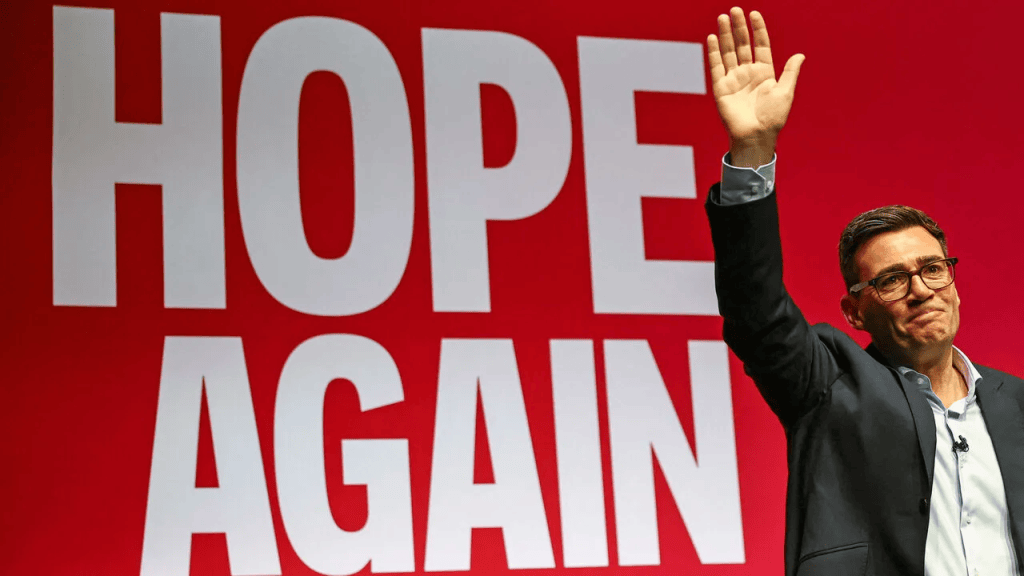
Andy Burnham also has another gift which perhaps aids him further in his quest to replicate Carney’s success in Canada. That is, he is an excellent communicator. There are two pictures below – one of Keir Starmer’s speech to Labour conference in 2025, and another of Andy Burnham’s in 2026. I have chosen images which are perhaps more evocative of my point, but it stands – Keir Starmer was like a politician. He stood behind a podium and lectured. Andy Burnham is not. He engages with people and has a gift of appearing to be on the same level as them.

This is not to say the podium is the mark of a poor leader – it isn’t. Blair and Carney spoke behind one, as did Boris Johnson. But it does demonstrate skill as an orator and an ability to connect with the electorate.

Burnham and Carney share one other thing, and I argue that it is the thing driving the rise of the populist right (and to a lesser extent, the left) across the Western World. This is that the recent years have belonged to, in my eyes, outsiders. Trump, Farage, the AfD, Le Pen, and even Boris Johnson. These are people who have been or styled themselves as outsiders, and who have managed to capture people’s legitimate frustrations and turn them towards their political cause. Left-wing politicians have done the same albeit often less successfully – look at Zack Polanski’s appeal amongst young people by capturing what matters for many young people (although with little serious policy proposals). As Mayor of Greater Manchester, Andy Burnham grew to understood the reasons behind this frustration well, and is therefore well placed to act and speak like an outsider.

Burnham has captured the public mood. The fact his proposals to meet the needs of the people are left-wing don’t, in my eyes, matter to the electorate. It is too easy to fail to remember that most people are not passionately left or right wing, and most people view their own politics as common-sense. When people see good ideas, they tend to like them. Of course there are competing needs between demographics, but knowing what is frustrating people and honestly trying to solve these challenges is a good place to start, and line Andy Burnham up well to emulate Mark Carney’s success.

Bullet: The collapse of the Tory Party should be a warning to Reform

At the end of next week, I think politics will look quite different. We’ll have had another TV debate, and this time one in a format that suits Starmer, and I’m sure his team will have pointed out his flaws. Reform, Nigel Farage’s party, will continue their rise in the polls. And, I think, they’ll overtake the Conservatives. Not once in post-war history has the governing party finished third place. It is unprecedented.

Various political analysts have tried to pinpoint where it all went wrong for the Tories. Was it partygate, or appointing Chris Pincher, or electing Liz Truss, or the direction of Sunak’s government, or the shift to the right? My stance is that this disaster for the Conservative Party has been a decade in the making.

To recap: In January 2013, David Cameron went for another term in office – successfully – and fought off UKIP by pledging a referendum on EU membership. That referendum resulted in a vote to leave the EU in 2016, and David Cameron resigned. Theresa May became leader and attempted to deliver her version of Brexit, and called the 2017 election to strengthen her majority. The Conservatives lost their majority, and Theresa May wasn’t able to unite the party on Brexit. In 2019, she resigned and Boris Johnson took over. Again, Johnson couldn’t persuade Parliament to back his version of Brexit. He called the 2019 election, and this time his leadership was about a single issue: getting Brexit done.

That sounds great for Boris Johnson. He enjoyed a popular couple of years in office, firstly delivering on his main pledge, and then leading a highly-approved (at the time) response to the pandemic. But soon, the unity was over. A party united around Brexit, and a country united around getting through coronavirus, now had nothing to unite behind. Boris Johnson introduced levelling up, but this faced two problems. First of all, it was place based, and Conservative MPs represent two very different types of places – think Jeremy Hunt compared to Jonathan Gullis. Second, this was effectively “improve outcomes”. Surely every MP should be united behind better sociodemographic and economic outcomes anyway?

Thanks to partygate – or rather, Boris Johnson’s lying about partygate – the party found itself with no ideology, no goal, and now no leader to unite behind. Cracks begun to show, with traditional Tory MPs finding themselves at odds with the 2019 intake. MPs who had won (and won, and won, and won) their seats based on centre-right politics were in the same party as those who found themselves in a job thanks to Johnson’s personality.

As the Conservative Party began to slip in the polls, it resorted to more divisive policies, and for two reasons – largely due to the aforementioned divisions, but the long Conservative rule meant the party was stale and out of new ideas despite being desperate for them. Not only bad for the country and liberal democracy, these tactics also further divided MPs. The Rwanda plan (which Rishi Sunak didn’t even agree with), the arguments about trans rights, and now national service are all tactics seen as necessity but which do damage to the Conservative Party.

If the Reform Party ever get into government – which I find unlikely in this election cycle, and probably the next, but not an impossibility in the long term – they are likely to face precisely this challenge. They have both an asset and a threat in their Boris-like campaign coalition. A charismatic leader and an easy soundbite to rally around can win power, but it can also cause the demise of a party if not properly planned.

Let’s say Reform get into power with a flagship aim of net-zero migration. They achieve it within 2 years. What next? It is a deeply right wing party that simultaneously supports British institutions like the NHS which is socialist in its roots. Social conservatism isn’t popular in the UK and may not be uniformly popular in Reform supporters. There is no coherent economic view in the party, with agreement on tax and spending coming secondary to immigration figures. Whilst it may enjoy short term electoral success, the Reform Party is in no position for real, long-term government.

Bullet: David Cameron is the symptom. But what of?

September 11 2001 was a good day to bury bad news. It seems Rishi Sunak had the same approach today, but the opposite way around: have some bad news, so create a day to bury it.

Braverman was all over the headlines over the weekend, and it looked bad for him. For a government that promised integrity, breaking the Ministerial Code wasn’t something he could easily forgive, and for a political lightweight such as Sunak, political challengers are something best avoided. Openly forgiving her and allowing her to continue wasn’t an option, and neither was making a significant deal of her resignation. Bringing in David Cameron as foreign secretary probably wasn’t because he is particularly well regarded in foreign affairs – he isn’t – but rather because he needed something to make the headlines today that wasn’t a disaster of his own making. And, frankly, it worked. You may well not be aware that Sunak got a no confidence letter submitted about him today, and you’re not to blame.

This means David Cameron’s return to frontline politics is, effectively, a symptom of Rishi Sunak’s political cowardice, which itself is an almost inevitability of his lack of parliamentary or public mandate. But what does it mean?

To begin with, not only is dragging a former Prime Minister back to hide your weakness a significant symptom of said weakness, but especially so for Rishi Sunak. He has very few political allies he can draw upon. He is seeking to move the Conservative Party away from the socially liberal and optically centrist May-Cameron era. Johnson most likely isn’t a name Sunak wishes to have attached to his own, particularly given that both were issued fixed penalty noticed. Truss is Truss. This is not Sunak drawing on a longstanding ally who is well versed in the relevant area of political life.

Nor is it Sunak shifting his direction of government back to a centrist one, even if Matt Hancock believes it is. For one, Sunak lacks the mandate to make such decisions, as is evidenced by the Braverman situation – he doesn’t have the capacity to pull all the strings of government, only those begrudgingly granted to him by MPs who didn’t put him there but knew Truss had to go. Not only this, but Sunak is doing everything he can to appease the so called New Conservatives – socially conservative 2019 Tories who have a big focus on reducing immigration but also on “gender critical” views – amid a discussion that they’re encouraging Braverman to make a leadership bid. Sunak’s given them a string to pull in the form of Esther McVey. And whilst the meeting didn’t go successfully – Sky News says less than 10 MPs turned up – a loud group of co-ordinated backbenchers probably isn’t great for a weak PM.

There is another explanation of what Cameron’s return may be a symptom of, and I think it may be this in addition to the aforementioned. Sunak has a narrow pool of MPs that won’t cause him problems. Given the reason behind his weakness is his lack of parliamentary mandate, this isn’t surprising – Conservative MPs never actually gave him the go ahead. They just didn’t stop him. His appointment to one of the great offices of state has already caused him some problems, and he’s already almost guaranteed to lose the next election, so he may well be looking for somebody with no leadership ambitions to quietly do their job. I imagine this isn’t an easy feat in any Conservative Party, let alone today’s.

Regardless of the diagnoses, today marks a day where Sunak’s government is diagnosed with something. He can figure out what it is, but there will be new challenges to navigate. What happens if he wants to sack Cameron – or, worse still, his loud backbenchers do? Sunak’s fixed the headlines today, but complicated an already difficult balancing act in the process.

Long read: Brexit, Corbyn, and regicide: Why parliamentary sovereignty is not to be challenged

“The public doesn’t bring down Prime Ministers; Parliament does.”

The sovereignty of Parliament has never been shown to be so obviously so important compared to now. No matter how loud the views are amongst the grassroots of a party or a cause – it must command a majority within Parliament, or at least within the Parliamentary Party. I could talk about my opinions on Parliament and the Lords and the electoral system – in fact, I did in my first draft of this post – but that isn’t relevant here and now. What matters is that every party learns and understands that it runs the risk of repeating the mistakes of the past if it does not begin to quickly listen to the realities of a world-class political system.

Liz Truss is, by every single measure conceivable, the worst Prime Minister we’ve had. Probably ever, certainly in modern history. By time in office, by number of u-turns, by policies delivered, by confidence of her own MPs, by confidence of the Commons, by the value of the pound. She has been so poor. And, this may be controversial, but I do not believe it to be something extraordinary about Liz Truss that has caused this issue. She was no weaker than May, and her policies were no more outlandish than Thatcher. The combination may have been fatal for her, but there is more to it than that.

The results of the (first) 2022 Conservative leadership election give it away. She came third in the first four rounds of MP ballots, and second in the final round. She entered office without a majority of her own Parliamentary party. Her mandate is Parliamentary, and Parliament’s mandate is the public. One of my deepest and most pragmatic beliefs about our democracy is that it is, and should remain, Parliamentary. There should be no constitutional requirement for a general election if a leader changes. Sure, opposition parties are right to call for one and I would like one, but there should not be a constitutional requirement. And so, whilst the governing party had an effective mandate from the public (regardless of your views on FPTP), the leader had no mandate from the governing party’s sovereign body: MPs. The party of regicide was always going to oust her as leader if she did not gain their confidence quickly. She didn’t. They did.

This could be a little different if she started out in opposition and gained MPs. Boris Johnson was so successful on Brexit because he was so ruthless with the MPs that he gained; any MP who ran in the 2019 election had to support his Brexit deal. Therefore, there’s a theoretical argument that opposition parties have a little more leeway with this and can listen to their members more, as they can – if they get into government – force their majorities into having confidence in them. This is only if you get into government, though, which brings me fairly smoothly onto my next point: if you’re an opposition party, it’s harder to get into government if you don’t have the confidence of your party. This shouldn’t be followed quite so stringently as it should be if you are in government; I know if I was still in the Labour Party, I’d want a say on the leader (and did in fact have a say on the leader last time). The 2016 Labour leadership election showed the flaws of this though, with 172 MPs against Corbyn, and 40 supporting him, he won the leadership election. He was never going to be able to unite or govern effectively, no matter how good his campaigning was.

This also applies to policy. The Brexit referendum probably made political sense to Cameron at the time. There was a rising party, UKIP, taking votes from him, threatening his MP’s majorities in swing seats. So, to shut them up and stop them from taking votes, calling a referendum and winning it wasn’t a bad thing to do. The problem was what ensued afterwards, which has only become clear in hindsight. The Tory Party at the time was mostly remain-supporting, including Truss herself, a member of Cameron’s cabinet. Theresa May took over – who supported remain – and tried to deliver Brexit with a Labour Party opposed to her and a Conservative Party opposed to Brexit. The result of the 2017 election made things no clearer, with Labour running a Brexiteer candidate in Corbyn with a policy to remain in the EU, and the Conservatives running remainer May with a policy to leave the EU. How can a parliament have confidence in a policy when it isn’t entirely sure who supports it and who is against it? Boris Johnson seemed to, for all his flaws and corruption, understand the necessity of a clear unambiguous Parliamentary majority to deliver a policy.

In comparison, take the two most successful and influential politicians in modern Britain, Thatcher and Blair. They both had one crucial thing in common, which was the command and confidence of their parliamentary Party. The public doesn’t bring down Prime Ministers; Parliament does. When you realise this, and understand that the public didn’t bring down Thatcher, or Blair, or Cameron, or May, or Johnson, or Truss, this concept becomes significantly more important.

Imagine if Thatcher had been elected without the votes of her Parliamentary party. On the same policies, with the same backing from her party members and the same view from public, but with the Conservative MPs giving their support to a hypothetical alternative candidate. Her character would not have changed, and nor would have her ideology, but she would have found herself in a position that could have very quickly become untenable. She was an effective if disagreeable opposition leader and Prime Minister not because she had the backing of significant grassroots organisations, but because she respected the sovereignty of the House of Commons and its importance in deciding the fate of an Opposition Leader and a Prime Minister. Blair’s mandate did not come from the party members – Corbyn had a bigger backing of party members than Blair did, albeit not by much. But, put two opposition leaders up side by side, one with the backing from their Parliamentary party and another with grassroots support. Nine times out of ten, I believe, the one with backing from Parliament will be more successful than the one with grassroots support. The public can vote for somebody who does not have the support of various grassroots movements – they can’t vote for one who doesn’t have the backing of their own legislators. If they do, it will only be a matter of time before downfall from within.

Bullet: The inevitable end for Liz Truss

I now feel confident enough that the end is coming for Liz Truss that I can write and publish this. I’ve thought for a while about how awful she is at speaking, campaigning, governing, and decision making – all the things that are absolutely essential for a Prime Minister. On top of that, she’s polling at around 20% (with another big result expected at 5pm today from Redfield & Wilton), and there’s rumours that there’s 100 no confidence letters already sent to Sir Graham Brady, the chair of the 19222 Committee. This is not something any Prime Minister has survived.

Prime Ministers very rarely get formally pushed out, so while it’s worth bearing in mind that the letters formally can’t be used to oust her, she is likely to choose resigning with some sort of grace over the alternative option – the 1922 Committee having to change their rules to allow themselves to sack you after less than 2 months probably looks worse than saying “It’s clear my ideology isn’t what was needed at the time I was elected, and so I will be offering my resignation to the King.” And, in that sense, I believe that where there is serious and growing doubt that she will survive, that means the decision has already been made.

Jeremy Hunt is expected to entirely reverse Liz Truss’ mini budget, which comes after she put her confidence in Kwasi Kwarteng only to be forced into sacking him. This will look better for Hunt than it will for Truss – and it is quite something when a Chancellor who has been in the job for 2 days and was one of the most unpopular Health Secretaries in living memory announces tax rises and spending cuts, and comes out of it in a better position than the Prime Minister. He’s fixing somebody else’s mess, but Truss’ constant presence through the two Chancellorships and her endorsement of the mini-budget means for her it’s too late.

She has only a mandate from Conservative members, remember. She wasn’t the first choice for MPs for leader – in fact, she came third behind Penny Morduant for the first four of five MP ballots. And, whilst we do formally have a parliamentary democracy where people vote for individual MPs to make the decision for them, it would be foolish to pretend that Boris Johnson isn’t the man who won the 2019 election for the Conservatives, with Jeremy Corbyn being the man who lost it for Labour. Whilst her government has a public mandate, her Premiership does not, and she tell MPs that she won them their seats in a way that Boris Johnson could.

Hunt is also expected to limit Truss’ energy support package. This is the only place where she has the upper hand on Labour at the moment; in PMQs, you will often find her saying “We’re commiting to support for 2 years – Labour’s plan only lasts six months!” If that commitment of 2 years is no commitment at all and entirely dependent on who went in the metaphorical revolving door at Number 11 in the last month or two, where is her upper hand against Labour? It is not funding public services, nor is it low tax, nor is it honesty, nor is it sound decision making, nor is it fiscal responsibility and a strong economy, nor is it stable leadership, nor is it having a likeable leader.

Hunt may be making better economic decisions than Kwarteng, and might even boost his own ratings if he says he’s making tough decisions to clean up the last guy’s mess. But, in doing so he will deliver a fatal blow to Liz Truss that will show within the next fortnight as her economic policy is dismantled by her own party, making her the shortest serving Prime Minister by some considerable distance in modern history. A Conservative Chancellor cleaning up a Conservative mess (against the fundamental ideology of the Conservative Prime Minister) caused by a Conservative Chancellor appointed by a Conservative Prime Minister is not a good luck for the Conservative Party, and it’s much worse for Liz Truss. Her lack of a Parliamentary mandate is coming for her.

Bullet: What Boris Johnson’s result means for the Conservative Party

In 1989, Thatcher had the confiendence of 314 of 374 Conservative MPs. A year later, she left Downing Street in tears. In 2018, Theresa May had the confidence of 63% of Conservative MPs. Six months later, she resigned outside Downing Street in tears. In 2022, Boris Johnson had the confidence of just 58.7% of Conservative MPs. A year later, what will happen?

In the coming days, expect the airwaves to be littered with Raab, Patel, Dorries, and company explaining how the win shows the country wants the Prime Minister to get on with the people’s priorities. They’ll probably talk about how he still clearly has the priority of the government the people elected, and that Labour’s political gains didn’t work. Above all, it’ll be that now is the time to “move on” and “unite behind the Prime Minister” to “get on with the job”.

None of this will actually mean very much. Whatever happens next, Boris Johnson’s critics are emboldened, and his supporters are weakened. Whilst you’re not going to see many voters remembering that Boris Johnson got 211 votes for and 148 votes against, the Tory party will be quietly remembering. The condition of support for the Prime Minister will slowly but surely go unrealised, and the party will be a party that no longer gets things done. Public calls for unity will be going to the wrong people, with MPs not changing their minds. Those who vote no this evening will likely hold that position for the remainder of his premiership. From public statements, it is clear that the no decision is taken after much more consideration than a yes one. In other words, the Tory Party will be no more unified than it is this evening for the rest of Johnson’s leadership, even if its division is quieter.

It’s hard for me to predict how Johnson will go, as this isn’t a matter of policy but rather a matter of character. With Theresa May, there was a failure in her flagship policy which forced her into stepping down – a clear pinnacle of what had brought about the confidence vote. With Johnson, this might not happen. Sure, he might break the law again, or the ministerial code, but I doubt it. I’ve a feeling it may come down to an election. Where Mrs May had a moment where it was clear her Brexit failures were sticking around, Mr Johnson may have a moment where it’s clear his character flaws are doing the same. Keep an eye on June 23rd, but don’t expect it to be monumental.

That’s why I think the death of the premiership will be a slow one. A slow realisation that Labour’s lead isn’t going anywhere (so, please, don’t fuck it up, Mr Starmer). A slow realisation that 2019 was a one off win for Johnson. A slow realisation that a suit and tie Tory is electorally better than a wine and cheese one. People will begin to realise the government is sad and limp, but there won’t be an event that kills it off. The Johnson government is terminally ill, but won’t be euthanised. Maybe there’ll be a week or a few of hospitalisation before it passes where things are dire, or maybe the party will realise that killing a wounded animal can be more merciful than forcing it to suffer. It could cling on until Labour kills it. But, make no mistake: I believe this to be a diagnosis that this government won’t be healthy again.

And so, with the exact end of Johnson unknown, I turn to post-Johnson and look at his successor. The Tory Party turning from such vocal support of good old Boris to a desperate attempt to rebrand themselves will be interesting at least. This isn’t impossible – look at Starmer’s Labour. But also remember the “Same Old Labour” tweets from the Tories; they know how damaging it is to say that a party hasn’t moved on from its unpopular previous leader. The big names in the Tory Party are the pro-Johnson ones, so the next leader will have to be chosen carefully. Where May’s front bench could be elected as leaders with different Brexit policies, Johnson’s front bench may be unpopular amongst backbenchers and rebels. My guess is Hunt – name recognition, few scandals or baggage, and ministerial experience.

Whatever happens, a random Monday in June has changed British politics for the next few years. Johnson may cling on until the next election or he may be forced out within months, but I can say with a significant degree of confidence that Johnson has no more than half a term left regardless of how his leadership comes to an end. Remember, of 359 Conservative MPs, he only has the support of just over 200.

Bullet: The confidence vote in Boris Johnson

There’s a reason that you hear stories of employers telling people if they don’t resign, they’ll be fired: resigning is a lot more pleasant than being fired. There’s a reason I say this. If Boris Johnson genuinely feared he’d be kicked out of office, he’d probably have resigned by now. I’d be careful about buying into the hype that today is Johnson’s last day.

There’s a few reasons this could shape out to be a little different (and I certainly hope it does), but I think it rings true nonetheless. That means that this vote isn’t one to watch believing it will change much externally. Glue yourself to BBC News, but don’t do so with a genuine belief that his time in office has come to an immediate end. At the end of today, the chances are that Boris Johnson will still be Prime Minister (even though a win today will leave him weaker than he was last week), and most of the public won’t really care that much about the numbers. They’ll see the vote, win or lose, and move on with their lives. That’s why I believe the best way to look at this is from within the Conservative Party, and how this could spell change in politics over the coming months and years.

So, let’s say he wins. This is the most likely outcome in my view. The big bit of news his how comfortably he wins and what this means. A comfortable win not only gives Boris Johnson safety, but also signals something wider: the Conservative Party have no intentions of distancing themselves from Boris Johnson after the Sue Gray report. That’s not to say they won’t ever, and it’s not even to say they won’t before the next general election. But it does make clear that, right now, the Conservatives are the party of Boris Johnson. Labour can use that to their advantage in the future. When Boris Johnson is no longer leader and if the party makes an effort to move away from him, a comfortable win today will be a reminder that they were more comfortable with a lawbreaker than they were with an electoral liability.

If he wins by a narrow majority, things don’t look good either. It gives hope to rebels that they’ll be able to get rid of him. Whilst he’s protected from a VONC for a year, Britain’s only two female Prime Ministers Thatcher and May both resigned well within that yearly time frame. Yes, he’s protected, but divided parties don’t win elections, and Tories get rid of leaders that don’t win elections. If the vote diagnoses the party as one divided, it may spell trouble for the Prime Minister, as he becomes aware that he could be doomed to lose the next election. Remember that a narrow win amongst those who once almost unanimously did not oppose him is no real win at all.

The 2019 intake is a big group to watch, as these are the MPs that are there because of Boris Johnson, and their support or lack of will be at least somewhat reflective of the views in the red wall. This will have its limits, as an MP of any party won’t be completely reflective of their constituency, but a big loss of support from these could send a message to the rest of the party: Boris Johnson won’t win these seats again. The entire vote should be seen as a series of messages from some Conservative MPs to others – some groups and individuals will be announcing that they still believe they keep their seats because of Boris Johnson, whilst others believe they do so despite him.

The timing of this is significant for Conservatives wanting to cling to their seats, too. Boris Johnson had a big success in 2019, but has suffered a big defeat in 2022. His plea to MPs is that things will get better, and that he’ll soon enough return to the 2019 glory days of Conservative support. Winning this can put partygate behind him, he argues. But in just 17 short days, he faces two by elections from very different demographics – the classic Conservative stronghold of Tiverton and Honiton in Devon, and Wakefield which was gained by the Tories in 2019. A bad performance in one of these, let alone both, is bad news for the Conservatives in the future. They may well be aware that if they don’t get rid of him today, they can’t get rid of him post-election. This is made worse by polling in Wakefield suggesting the Tories would get roughly what they got there in 1997 when Blair won a landslide – 28%, which is almost 20 points down compared to 2019. Votes against the Prime Minister may well be “shit, I’m at risk” votes, rather than “I like public standards” votes. Those who support Johnson will also be aware that the Conservatives are behind in the polls, and will be supporting him on the condition that things improve electorally when (if ever) all this party stuff is behind him.

This is why I’d be wary of predictions by Labour optimists that Johnson will call a general election. If Labour supporters are hopeful he’ll do it, it’s all the more reason he won’t. Early general elections are for parties that are doing well in the polls and don’t want to risk a fall, not for those who wish to strengthen their mandate after a period of weak performance. Ask Theresa May how well it went for her. The real thing we should be watching is can Boris Johnson win back support that is shown as lost this evening? If he can’t, that’s when I predict his days as Prime Minister will be behind him. The reason I hesitate to give him a year’s timeframe is that I don’t think his end will be a VONC as it won’t be brought about by something new but rather an old issue lasting, and he’ll be pressured into resignation.

The long and short of this is that Boris Johnson will probably win, and he probably won’t call an election. He’ll be Prime Minister tomorrow and Conservatives will be in power for a while yet. But, the rebellions may be bigger than expected and spell doom for the Prime Minister in the long run, with some Tories realising they’re at risk. The real speculation worth paying attention to is not that there’ll be a general election, but that things will either get better or dramatically worse for Mr Johnson. The coming months are make or break for Johnson’s premiership.

P.S. If he resigns today, he’ll have lasted one day less than Gordon Brown, and I think that’s quite cool.

A year in office: Biden’s missed Supreme Court opportunity

When Ruth Bader Ginsburg died just 6 weeks before the 2020 Presidential Election, Mitch McConnell was keen to have the Senate confirm one of Trump’s Supreme Court nominees before it took place. This is despite the fact that McConnell himself was very clear in 2016 that the Senate would not hear any of Obama’s nominations for the Supreme Court justice to follow Scalia an entire 9 months before the 2016 Presidential Election.

For those of you who don’t know, the Supreme Court is made up of nine justices to uphold the Constitution of the United States. Those justices serve life terms, and they’re replaced when they resign or pass away. A President will nominate a justice to fill a vacant seat, and the Senate will vote to confirm that justice. This process has become politicised, with Presidents appointing justices who will fit their agenda – Republican Presidents will appoint justices that take a pro-life interpretation of the Constitution, for example, whilst Democrats will appoint justices more likely to uphold Roe vs Wade (the ruling which legalised abortion nationwide).

This politicisation of the Supreme Court has, for the most part, been played quite nicely between the two sides. If the Senate sees a qualified candidate, it will generally appoint. However, this precedent was resigned to history in 2016 when the Senate Majority Leader Mitch McConnell said that the Senate would not even hear the case for an Obama appointed justice – nothing would happen until the new President, whether Clinton or Trump, was inaugurated. Fast forwards four years to a Trump administration, and McConnell was eager to backtrack on his precedent and appoint a justice before a Presidential election. With the disregarding of one precedent, another was set: one of ignoring good faith and past precedent. Whatever the GOP (another name for Republicans) say in one case, it’s not for the sake of the nation, Constitution, or good faith, but rather for the sake of furthering their own agenda. Will they force through a poor quality nomination to strengthen the conservative majority on the Supreme Court? Absolutely.

With the Republicans brazenly playing dirty, Biden should have done the same. The letter of the Constitution applies, of course, but not the spirit. Anything the Democrats restrict themselves from doing now will only be done by the GOP further down the line, unless it’s constitutionally disallowed. That leaves two options for ideological success: do something first, or make sure it never happens. And so comes forth the idea of court expansion, which we’ll return to later. The court is made up of 9 judges, and past precedent has kept it this way. Obama only nominated when 9 became 8, and Trump did the same. However, there’s no rule that says this has to be the case. The exact words of the Constitution with regards to the Supreme Court are as follows:

“…he shall nominate, and by and with the advice and consent of the Senate, shall appoint ambassadors, other public ministers and consuls, judges of the Supreme Court, and all other officers of the United States, whose appointments are not herein otherwise provided for, and which shall be established by law: but the Congress may by law vest the appointment of such inferior officers, as they think proper, in the President alone, in the courts of law, or in the heads of departments.”

In plain English, this reads along the lines of “The President can nominate Supreme Court justices with the permission of the Senate [amongst others]: but Congress may put legal limits [age, criminal background, etc.] on who can take up these roles.” There’s absolutely no mention of an upper limit of justices. I could talk about the many pros and cons of a Constitution in the formate of America’s, but this is one of its flaws: it’s taken literally and incredibly hard to change. No mention of an upper limit? Then there’s no upper limit until 3/4 of States, 2/3 of the House and 2/3 of the Senate agree.

So where is – or was – Biden’s opportunity for Constitutional change? When discussion of court expansion came up in the campaigns and debates for the 2020 election, Republicans were opposed – or at least the voters were. If Biden could get the Democrat members of the House and Senate on board, which he probably could given the GOP’s history of doing everything they can to sabotage the Democrats, he can then say to Republicans: here’s your chance to stop me from expanding the court. And it could well be electoral suicide for many Republicans to say no, given Biden’s unpopularity with their voters.

The Republicans have already proven they’ll play dirty – if there’s nothing Constitutional preventing them from doing something, the chances are they’ll do it. This means that, if a 2024 Trump Presidency happens, the court may well be expanded with conservative justices if no safeguards are put in place to prevent this. The controversy has died down now, meaning Biden has less fuel to ignite Constitutional change, and the Republicans have their eyes firmly set on returning to the White House. If they can do this, they could well take full control of the Presidency, House, Senate, and (in effect) the Supreme Court. It may be too late now, but Biden’s refusal to rule it out in the 2020 election means that the GOP can get away with it with little legitimate criticism from Democrats, and politicising a judiciary is never a good idea.

Hopefully this opportunity isn’t missed, and hopefully Biden realises that the best thing for America is to rule out Supreme Court expansion in order to keep it as nonpartisan, or at least bipartisan, as possible. However, I have a feeling that neither of those things will be true: court expansion is an issue at the back of voters’ minds if there at all, and Biden doesn’t seem to want to rule it out, leaving an open door for Trump to give America its most conservative court ever.

Bernie started a revolution: that’s where he went wrong

I knew of Bernie Sanders in 2016, though I wasn’t really old enough to be engaged in American politics back then so I couldn’t offer an opinion. In February 2020, I was throwing my weight behind him. Pictures of massive rallies full of people – Americans – supporting democratic socialist policies filled me with hope. He was America’s chance for healthcare that made sense, for university that didn’t throw people into hundreds of thousands of dollars of private debt, and for real action on climate change. It was the first time in my lifetime where I thought “Oh my god, things could really change in America”.

That’s kind of the problem with Bernie, too. Not the policy, but the messaging. He hit the nail on the head when it came to young progressives like me and many others – anger at the system which translated into radical, transformative change. That’s why I was so passionate and hopeful. Throw the same messaging at the lower middle class in the rust belt, and you’ll probably find that people working in car manufacturing who have just barely got health insurance won’t respond too fondly to the rhetoric of “let’s rip up the system”.

A middle ground is hard to find. My idea of the best middle ground is keep the anger, but don’t direct the anger at capitalism or cars or an abstract “the system”. Direct it at not doing the common sense thing. Keep the anger for the young progressives, but don’t talk about healthcare as some kind of revolution. Talk about healthcare in familiar terms. In practice, this means straying away from “We must defeat them” language (which I just copy and pasted directly from Bernie’s website), and towards “It’s common sense – we can fully insure everyone at half the cost.” Everyone knows common sense, and Americans are familiar with being fully insured.

Bernie had the right ideas. American health care makes no sense. It’s high cost at about 2x what most other MEDCs spend per capita, low efficiency given the bureacracy, and doesn’t produce great outcomes with a lower life expectancy than the UK, Germany, France, New Zealand, Canada, Japan, and 33 other nations. Based on WHO data the US is 40th in life expectancy – the UN Development Programme puts it 37th, and the CIA’s World Factbook places America at number 54. When it comes to spending it’s more shocking – in 2019, the UK spent $4,653 on healthcare per capita. The United States? $11,072.

Health expenditure per capita by major nation. Source: OEDC.

I could talk for hours about why healthcare makes no sense in America, but that’s not the point of this. A quick look at a bar chart shows it doesn’t make sense. The problem is why Bernie couldn’t get this message to cut through. Policy doesn’t need to change, messaging does. The UK faces a similar problem with Labour although it’s not compounded by the Electoral College – Keir Starmer is criticised for speaking in front of a flag of the country he wants to lead, despite the fact that Bernie Sanders did this consistently with little criticism from the left. If the Democrats (and Labour) want to win in 2024, they need someone who can win the hearts of the young and the common sense of the swing voters. Anger and common sense aren’t mutually exclusive.