Why Biden won’t win again in 2024

One of the things that I brag about most is that I called the 2020 election correct in every state (and DC, although not once in its voting history has DC voted Republican) aside from Georgia and Arizona, which both flipped from Trump to Joe Biden. I predicted it’d be the first election since 1960 that Ohio voted differently to the final result, and I predicted a narrow win for Biden overall. Whilst I won’t claim that I got it exactly right – because I didn’t – I will offer my opinion on the 2024 election.

The electoral college in America pretty strongly favours the Republicans. In fact, so strongly that no Republican President has entered office by winning the popular vote since George H. W. Bush in 1988. Following Bush Sr., America had eight years of Clinton, then Bush Jr. won without the popular vote. Whilst he did win the popular vote for his second term, he did so having entered the Presidency without it. Obama followed Bush Jr. for eight years, then the world was burdened with Trump who entered office despite Clinton winning the popular vote. This means analysis needs to focus on the electoral college and therefore on a state-by-state basis. If we only took the popular vote into account, we’d probably have had a Democrat President since 1992 – national opinion doesn’t decide the President.

This makes swing states in America particularly important. My 2020 prediction was based on the rust belt voting for Biden, but also on the high turnout I expected amongst left-wing voters, given that Biden had one of the most impressive rebranding efforts I’ve ever seen from a candidate: he went from pale, male and stale when against Bernie and Buttigieg to offering significant policy changes, a shift away from Trump, and the first female and ethnic minority Vice President. This was all against the backdrop of Trump’s failures. It didn’t make a win inevitable, but it managed to turn out voters in cities like Philadelphia and Atlanta to the extent where Pennsylvania and Georgia were just won.

Biden was able to get the support of workers who’d been failed by Trump’s pandemic response or had family affected by it, as well as young progressives, without one group alienating the other. Put bluntly, Trump’s pandemic response was bad and Biden offered real hope. Now, Biden’s just as bad (the CDC have recently announced that isolation can end after 5 days without a negative test, and a rapid test is at least $10), and doesn’t live up to what he promised, so he’s likely to lose a lot of these groups. Young people won’t turn to Trump, so the edge in some states could be down to mobilising these. And, frankly, why should young people vote Biden when he’s failed to write off student loans? Social policy is the one thing keeping young people voting Biden – but even there, Biden promised 0 deportations in his first 100 days. He missed the mark by tens of thousands. Workers under Biden? They’ve kept their healthcare, but they did under Trump too. Put short, Biden has underwhelmed in the areas that made him win.

On top of this, there’s the fact that in American politics, the first 100 days are what matter, and no legacy was left of this. At this point it’s an assumption that Biden will lose the House in 2022, so the GOP will do all they can to make Biden look ineffective. This is going to harm his chances when it comes to the 2024 race. In other words, Biden’s failed to impress when the Democrats have had control of the Presidency, the House and the Senate. If the Democrats lose the House or Senate, Biden goes from bad to worse.

Of course, this is all based on the most likely scenario of the Democrats nominating Biden again, but the alternatives aren’t much better. Either nominate Kamala Harris, the most unpopular VP in modern history, or admit the administration has got it wrong and lose the incumbency advantage by selecting a third candidate, which is virtually unheard of in American politics. There’s no way of getting out of the Republican firing line. It’s either “Look at how Biden failed to keep his promises to America”, “You don’t want Kamala Harris as President”, or “Democrats can’t even trust themselves – why should you trust them?”, the latter of which will open up easy goals for the Republicans as they ask the nominee what they think of the current administration.

Biden had the opportunity to impress. He could have written off student loans, made rapid testing free, made Washington DC and Puerto Rico states (therefore giving them seats in both the House and Senate, which gives the Democrats an electoral advantage), expanded the Supreme Court, made healthcare more accessible, implemented gun control and police reform, and invested in huge social programmes to cut crime. He had the numbers to do whatever he wanted to do, so he’s the only one to blame. In fairness, his Build Back Better plan does deliver on some things (and might be Biden’s last shot at saving the Democrats’ 2024 dreams), but his choices in the first 100 days might cost America four more years of political stability, and those four years might prove fatal with ill judged foreign policy and populist domestic supporters. When he’s not up for re-election, he may be even more reckless too. It’s his last four years anyway, what’s he got to lose?
Public transport isn’t that bad – so why is it so bad?

On the first day of work, I went to get the bus. I got to the bus stop far earlier than I needed to after severely misjudging how long it would take to walk, and hopped on one of the buses that take me from university to the city centre every 5 minutes. I was pleasantly surprised. The bus is capped at £4 a day, which meant that my 4 short rides to work and back worked out at a quid each. The buses were clean enough, quick enough, and I didn’t have any bad experiences. After using Citymapper the first few times, I can now get on and off buses with no problem.

So, why do I think the public transport network in Birmingham is so bad? I have a bus that leaves every 6 or so minutes to the city centre, a train every 15 or 20 minutes, and we have a tram system. Canals are cycle routes that are separate from traffic, and there’s a cycle lane from the south side of my campus most the way to the city centre. The problem is, we don’t have one reliable public transport system. What we have is a bus route that let me wait half an hour for a bus from a fairly central location to the bus interchange with no updates on when they’re coming, and the weekly cap doesn’t apply to all West Midlands buses – only National Express West Midlands ones, so if the wrong company turns up you’re out of pocket (as happened when I worked in Wolverhampton). We have a separate train system which is affected by any National Rail incidents, which is not uncommon given our ageing infrastructure. Separate to both of these, we have a bike hire system, which costs 5p a minute. Use it for a 10 minute bike ride to work and back, and you’re paying well over £200 a year. If you’re looking at 20 minutes it’s almost £500 a year. The tram system is separate and even I have no idea how to book a ticket for it, nor do I have any idea how much a ticket would cost. This leads to a swiss cheese effect for every form of public transport: in big cities at least, the strengths of one form of public transport tend to make up for the shortcomings of another – each slice of cheese covers the holes in another slice – but each slice of swiss cheese is an entirely individual entity instead of making up one swiss cheese system.

So, we can break this down into a few things. For the sake of this article I’m not going to discuss increasing funding or routes, but just common sense policies that could fix the problems. First of all, there’s information barriers. A big part of this is that buses vary from city to city. I had to get on a bus in my home town earlier this year and went to tap my card on, as I would in Birmingham. The driver looked at me with a confused face and said “You need to tell me where you want to go.” This might be a sign of my age (or lack thereof), but there was simply nothing telling me how to get the bus. I managed to deal with this because saying “town centre” wasn’t too much of a barrier, but not everybody has this privilege. To begin with there’s simply the practical elements – the driver knows where the town centre is. Someone getting the bus to a more obscure location might not know the name of the stop, which is already a knowledge barrier to making use of the public transport system. But knowledge isn’t the only barrier which occurs due to this lack of uniformity – those with anxiety may find it difficult to use public transport as they don’t know how it works and it’s hard to find out. Getting in your own car and driving is easy and you have control. Going on a bus where you’re not sure what’s going on? A little more daunting.

Not only this, but delays are more unexpected and frustrating. This is partly because you’re paying for a service: if you’ve paid National Express a tenner to get somewhere by noon and you arrive at 1pm, you’re not going to be the happiest of people. If you’re driving, nobody has made a promise to you, so delays don’t sting quite as much. But, as frustrating as this is, there’s a far bigger problem.

Transport isn’t unified in this country. If you pay for a train ticket, you’re paying National Rail, not the public transport system. So, when you’re faced with unreliability on just one part of the public transport network, that unreliability affects your entire ticket. Back in July of this year I was about to get on a train for my first day of work at my old job. For context, the train takes about 5 minutes from my stop to where I worked, and there was roughly a train every 20 minutes. My train was cancelled, and the solution offered by National Rail when this happens is to wait for the next train. Alternative forms of public transport are not included in your ticket, and nor is any information on them given. So, when faced with this delay, my ticket required I wait 20 minutes despite being a minute’s walk from my town’s bus stop. No information is given on buses either – it’s a “find your own way at your own cost” situation.

This could pretty easily be rectified on local scales. First and foremost, make tickets valid from location to location via any means of a unified public transport system rather than from stop to stop via a certain means. This means if your train from, say, Birmingham to Coventry is delayed or cancelled? That’s fine – it’s valid on any bus. Renationalise National Express and you’ve got coach options, too. A benefit of this is all the information’s in one place. There’ll be no multiple bus providers for the same route, no checking Trainline and then asking a nice stranger “which bus stand to the town centre?” and no figuring out your options on your own. What could have very easily happened in the situation I faced without buying another bus or train is a system where they say “Sorry, your train is cancelled. Passengers to ____, the fastest way there is the XX bus, departing from stand X. Your tickets will be accepted on this bus.” This doesn’t involve some huge expansion to the public transport network, it’s just common sense.

A more complex issue is ticket acceptance due to safety and fears given the current political climate. My housemate and I got on a bus to the city centre a few weeks ago, when a man decided to take issue with queerness and say to us “don’t make me straighten you out on this bus.” Needless to say we promptly got off – but where did this leave us? We didn’t know when the next would be (which I’ll deal with later in this article), and the next few were full. It left us out of pocket getting a taxi. Granted, the bus company have done everything reasonably possible to make sure we’re okay (which reminds me I need to call them back), but this doesn’t fix our issue – we had to get off a bus, the next two were full, and we ended up forking out for an Uber to the city centre. Unequal access to public transport, and indeed all public spaces, remains a huge barrier for many minority and at risk groups.

Additionally to the information that does exist, it’s not very reliable. You can generally trust Google Maps to get you to your destination within 5 minutes of the time it says on a two hour journey. Despite all the problems with data harvesting and tracking and surveillance this involves, it’s bloody impressive. On the other hand, the bus timetable says 16:30? There’ll probably be a bus at some point between 16:00 and 17:00. Okay, maybe that is a slight exaggeration for myself, but for many people in neglected towns it’s the reality. People can’t be expected to trust public transport with their journeys if they can’t trust the information it offers. The tracking of buses isn’t accurate either; I recall waiting for a bus that Citymapper said was 10 minutes away for about half an hour to get back from work one day. Whilst this is hardly the inconvenience of the century, it does undermine confidence in the system and the information it offers.

The same bus route home is also packed every single week without exception. I work in a school once a week, and I can say with confidence that the bus will be at capacity after the school stop every single week without fail. I wasn’t let on this week despite being at the bus stop (although this might have saved me from catching the Omicron variant, so I shan’t complain too much). Again, people can’t be expected to utilise public transport that fails to plan. Admittedly this is partly down to the lack of school buses, the urban area of the school, and potentially the household income of the average student at the school. Nonetheless, I have no access to historical data, but I know that the bus will be full from the school to the bus interchange every school day, and yet there is no planning to offer an additional bus by either the school (because of the disjointed nature of public services – it’d come out of the education budget, so fair enough) or by the bus provider. Yet again, confidence is undermined. People are told to wait for a bus that the provider knows will probably be full. Nothing is done to solve this.

These are all problems that could be solved immediately. Make buses the same from city to city with the information easier to find. Improve delay compensation on public transport, and make it easier to claim. Unify public transport, but in the meantime at least unify ticket acceptance. Improve punctuality, and improve warnings when it’s off. Plan for peaks, and even what I’ll call micropeaks – where one bus is unusable for 5 stops, as happens on the way home from the school I work in. Use historical data to forecast how busy a bus will be, and warn people of this in advance. Make CCTV obvious, make its data easy to access for authorities, and make the process of reporting incidents easy. These are solutions which don’t need piles of money – they just need smart people with good intentions working in the right industry.

The beginning of the end for Johnson, and why the Conservatives could be doomed at the next election

If the opposition manages to sustain a good attack line, this will be the end for Johnson. It is significantly more important than the fact that the Prime Minister probably shouldn’t have attended a party. It’s the fact that there were countless mistakes – if you can call them mistakes – caused by a culture of lying, arrogance, and refusal to follow the law. Any decent Prime Minister would have said “I should not have done this and I will step down” for the sake of the country. Any bad Prime Minister would have done the same but for their party, similar to Matt Hancock. Johnson is neither of those, and that’s what makes him so embarrassing.

There are three options for the Conservatives in the next election, likely to be in 2023 or 2024. Boris Johnson could stay leader and there could be too few rebellions to trigger a vote of no confidence within the Conservative Party, which isn’t unlikely given that Labour’s constant infighting over the last couple of years has made them look incredibly weak and divided, and the Conservatives don’t want the same fate. Boris Johnson expelled all MPs that did not agree with him on the issue of Brexit, as unity was so important to the party – so don’t be surprised if the Tories don’t rebel. If Johnson does stay leader, the opposition parties and hopefully the media will have a fantastic opportunity for some good old fashioned character assassination. Is the person who couldn’t follow his own rules and couldn’t be honest about it the person you want leading you through the next crisis, and can you trust them to make good decisions on behalf of the country when they consider themselves exempt?

The second option is that Boris Johnson is replaced as Prime Minister. I consider this the most likely. Potential candidates for his replacement will vote for replacing him but only if they believe it is likely to pass, given their careerist goals but also that they will want to stand on a platform, both internally and nationally, that they’re not like Johnson, whilst seeking to balance this with being supportive of a government which they want to look successful. Their electoral chances will be ruined if the front bench votes against Johnson who survives the vote. If Johnson is replaced as Prime Minsiter, Labour also have a fantastic opportunity for campaigning against the new leader: “In 2015, the country voted Cameron and got May. In 2017, the country voted May and got Johnson. In 2019, the country voted Johnson and got Sunak/Truss/Patel. They can’t trust that a Conservative Prime Minister is up for the job.” They’ll also get the chance to point out that many current Tory MPs will have supported Johnson as a vote of no confidence will force them to pick a side or abstain, and that there’s nothing stopping a party with such a corrupt culture from replacing the new PM two years down the line with someone more corrupt as happened with Johnson replacing May. It’ll be an attack on the party which supported Johnson so much and the risks re-electing that party brings with it, rather than an attack on the new leader.

I believe this will happen before the second half of 2022 due to the process involved. A Parliamentary vote of no confidence (which triggers a general election if no new government is formed within 14 days) won’t pass against Johnson if it didn’t pass against May, and the Tories would struggle to find a coherent leader in time for the 14 day general election leaving Boris Johnson as their candidate. This means it would have to be done through a Conservative Party vote of no confidence, where enough Conservative MPs (15%, currently 55 MPs) must write to the Chairman of the 1922 Committee to ask for such a vote. MPs are only going to write at such a time when they believe the party to be at risk because of the leader, and trailing in polls is not enough to cause this. If Johnson survives the local elections in 2022, it means the scandals have passed without enough outrage from Tory MPs to remove him and they won’t remove him with no new significant scandal. In other words – this set of scandals will end him quickly with the help of the North Shropshire by-election this Thursday and potentially the 2022 local elections, or it won’t end him at all.

The third option probably looks a bit more appealing to a lot of senior Tories – keep the government looking strong as long as possible without ousting Johnson as Prime Minister, but standing a new leadership candidate in the 2023/24 election. On the face of it, this looks good: suppress the scandals as much as possible, say you’re delivering on the people’s priorities instead of playing politics, and dump the liability without making a big deal out of it in the middle of a term. However, this raises problems for the next leader. Any attacks on Johnson can then be carried out on the party as a whole. The leader will be forced into criticising Johnson after standing by him for years, or will appear soft on Johnson’s corruption when it will likely be one of the main talking points of the next election. And this won’t just be a problem that the leader faces – the entire party will be accused of standing by a corrupt leader until it’s elecorally convenient for them, and it will be hard for them to wiggle out of this one.

Whichever of the three options happens, it could spell significant danger for the Conservatives at the next election as Starmer’s blandness turns into his biggest asset. It just relies on Labour running a good campaign against the Tories and knowing that it’s an election which will be won on attack, rather than left wing policy. Once Labour have a term proving themselves as competent governors once again, they can use the following election to stand on popular left-wing platforms such as renationalisation.

Instagram activism is hypocritical and lacks nuance. Why?

As a quick disclaimer, this post deals with some pretty sensitive topics. Whilst I’ve done my best to approach them with care, please bear in mind that it obviously isn’t my intention to offend or blame anyone as you read on.

At the height of anti-police protests last summer, my Instagram feed was filled with people very honourably and justifiably calling for the police to be defunded. The big issue on every university student’s mind was – rightly – the killing of Sarah Everard. Even for me, a white able-bodied man, it was impossible to escape the reality of the fear that women felt. A serving police officer had killed a woman. At the time I posted on Instagram highlighting the lack of “good” cops in the Met. Why shouldn’t women and men be calling for the defunding of the police as an institution when its officers have killed women and criminalised vigil?

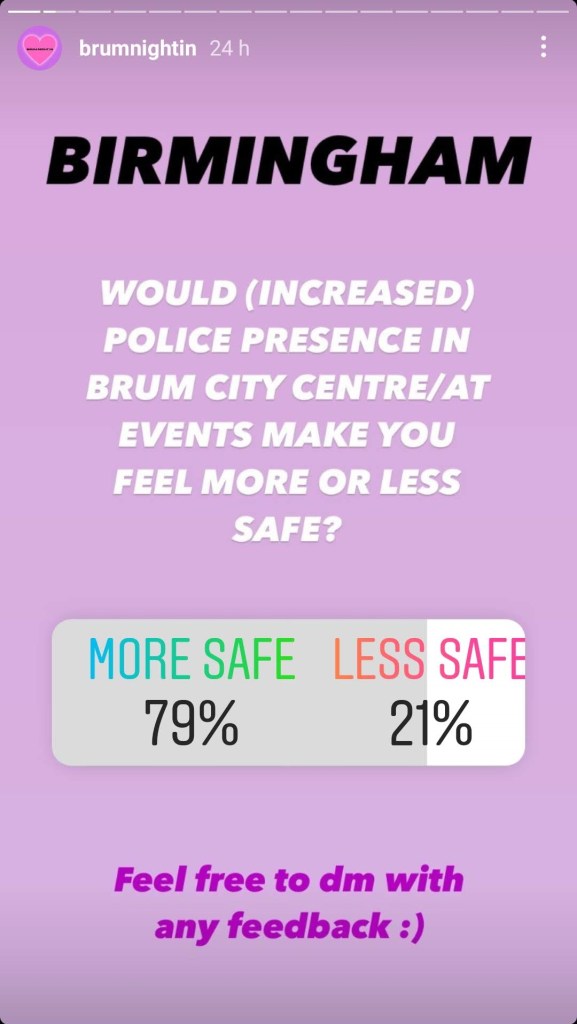
Fast forward to the return to universities this year. For my year group, it’s the first time clubs have been open when we’re at uni, and for the year below (and anyone born after March in my year group) it’s the first time they’ve been open since they turned 18. The issue on everyone’s mind is no longer Sarah Everard, but rather the fact that people – predominantly women – are being spiked by injection at an insane rate. A couple of weeks ago it was impossible to scroll through my Instagram stories without seeing another innocent person be spiked with a needle. A student group was set up at my university, on Instagram @brumnightin – calling for a boycott of clubs that don’t do enough to keep women safe. A couple of weeks ago, they posted a poll on their Instagram story – and these were the results.

The student population of Birmingham were, once again very rightly, saying that an increased police presence would make them feel safer. It would make me feel safer, so these students can’t be blamed.

That said, suddenly a student population that had appeared to overwhelmingly support defunding the police in summer had switched to wanting more police that winter. This is the embodiment of Instagram activism – a phenomenon significant enough that a fair few people will be familiar with the term already. I don’t seek to blame anyone here – I was the same: wanting to get rid of an institution that has, bluntly, shown no respect for women’s rights, and wanting women to feel safer in clubs. There’s no easy solution to this; the way I see it, people called for the right thing twice, but the two things they called for are incompatible with each other. So the question is, why does this happen?

As a geography student who has previously studied sociology, I’m acutely aware of how spaces are designed to make us interact with them in certain ways, and I think this can be applied to social media to figure out why Instagram activism, in particular, is so toxic. My belief as to why arose during a conversation with my wonderful mentor, Aisling, as to why I thought Twitter was so toxic – there’s so many arguments. Despite the flaws of these arguments (and believe me, there’s a fair few), they provide opposing viewpoints. I came to understand that part of the reason Twitter has so many confrontations is because of the way the platform is designed – click on a tweet and the option to reply is front and centre, you can’t delete the comments on your tweets, and the platform centres short text-based exchanges.

Instagram is quite the opposite. The replies are out of the way, you can delete and disable comments, and the platform is based on images. The general idea is you see an image and you like it or you move on, and the user interface runs with that idea. There’s nothing encouraging you to reply, and nothing really encouraging you to read the replies. Even the phrasing – “Tweet your reply” versus “Add a comment” makes Twitter encourage conversation and Instagram indifferent about it. Sure, the conversations on Twitter aren’t necessarily the most pleasant, but at least they’re there. I even had them forced upon me because I tweeted about fonts.

This is where the bandwagon nature of Instagram activism comes in. If you see a broadly agreeable Instagram post or story, you don’t go out of your way to scrutinise it or disagree with it because you’re simply not encouraged to. You either like it or move on, and when so many people are liking it, it’s extremely easy to get swept up with the dominant view at the time. At the peak of an event, story after story can be filled with well-intentioned friends sharing ill-researched posts. An example that comes to mind is a post on the Israel-Palestine conflict that was widely shared last summer and included the following:

“They are not ‘fighting’, Israelis are the oppressors and Palestinians are the oppresseed and the situation is about anything but religion.”

@key48return on Instagram

This was, quite clearly, a sweeping generalisation about every Israeli citizen based on the actions of the Israeli government. It ignores the complex history of the region and the fear that many Israelis face in the name of standing up for the oppressed. It is one thing to say the Palestinian people are oppressed, but it is a different matter completely when you say every Israeli is the oppressor. Yet proud anti-racists shared it far and wide because they saw it as standing up for an oppressed group. And, to me at least, it seems this happened because of Instagram’s aversion to dialogue. You don’t come away from the post with a balanced view, because you don’t see a conversation – all you see is an infographic taking up half of the screen, with “Liked by someone you know and 300,000 others”.

So how can we fix this? Well, Instagram can fix it, at least partially, by offering more room for dialogue given that the platform is becoming an increasingly political platform which inevitably leads to it becoming a bigger echo chamber for at least some users. They probably won’t fix it though, given that the app has been based around big images with just a bit of text since its creation. That leaves the burden on Instagram users to be more willing to criticise infographics when they’re one-sided. Look at the account of a post before you share it – what’s the bias? It also needs to be understood that complex issues, whether it’s the police, race relations, or international conflicts, can’t be reduced down to a simple 10 slide Instagram graphic, and nor should they be. Issues like this need time, depth and nuance, and when they are discussed on social media they need dialogue at the very least.

This post was in part inspired by a Vox documentary on how colour schemes on Instagram have been used to make infographics look progressive when they are the opposite. You can watch it on their YouTube channel here.

The mistakes the government are making as we speak on the Omicron variant

If you turn your watch back to February and March 2020, the government took a different approach to coronavirus than the rest of the world took. They kept borders open and kept social mixing. In fact, I remember being in a politics lesson when my teacher predicted that the government wouldn’t close airports for economic reasons – and he was right. Until January 2021, the government failed to close travel corridors to protect against new strains of coronavirus. Who can forget the chaos when the Alpha variant was allowed to make its way through the population. The situation can evolve so quickly that there were three days between Boris Johnson saying it would be “inhuman” to cancel Christmas, and him doing just that.

I’m a big opponent of using lockdowns as a public health measure – the social and health choices of individuals should only be curbed to avoid national emergencies, not as a public health tool. However, my view only extends to domestic policy – not travel restrictions. As of yet, the UK doesn’t think it has any cases of the new variant. We, right now, have a chance to continue socialising and avoid any limits on social gatherings, which is something we should all seek to do.

However, as soon as a case of the variant is detected in the UK, it is too late. They will have been infected by someone else, and they will have spread the virus before testing positive and isolating. This is not rocket science – it’s common sense, and it’s the principle that allowed countries like Iceland to avoid lockdowns. As soon as there’s one case, there’s more. The UK policy once centred around the R number, so it’s a concept that most of us understand well enough by now – 1 case spreads to 2, which becomes 4, becomes 8, becomes 16, becomes 32, becomes 64, becomes 128, becomes 256, becomes 512. One case spirals out of control. It happened with the original variant in March 2020, it happened with the Alpha variant at Christmas 2021, and it has the potential to very easily happen again with the Omicron variant.

The government seem to, yet again, make the same mistake here, prioritising the travel freedoms of the international community to the UK over the social freedoms of the UK population. They hope this variant will be okay – and I hope it will be okay too, and I hope that this post is proven wrong. However, we have far more to lose in civil liberties (which, make no mistake, may be necessary when the time comes, but are not unavoidable if we act now) than we do by restricting international travel to the country. When it comes to the rights to socialise, protest, and even get an education of the people in the UK, the government is too keen to play down a situation than it is to act quickly to protect an as of yet protected nation. Maybe zero Omricon won’t be possible, but there is so much freedom and so many lives to potentially lose if the variant makes it into our borders before we know more about its transmission and its lethality, and before we have the infrastructure (or, more likely, political will) to isolate and trace every case of it.