Stop the small votes: the end of fringe and populist politics?

Perhaps fringe politics is the wrong word, acknowledging that Reform held a comfortable lead in public opinion polls for over a year until Starmer resigned, and the Greens have, at times in the last year, overtaken Labour. But there is no doubt that Reform are further right than the Conservatives, and the Greens further left than Labour. Both were once fringe parties, reflecting in their small number of MPs. And both are populists – something which I don’t like.

It is no surprise that my last two posts have been positive about Andy Burnham. He shares my politics almost exactly. I would describe us both as ambitious but pragmatic social democrats. I am sure Andy Burnham could make a compelling case for the abolition of tuition fees. I am also sure that he understands that it shouldn’t be priority number one in times of economic uncertainty. He is pro-city and pro-devolution. That’s where I land. Andy Burnham just has vastly superior experience and communication skills than me.

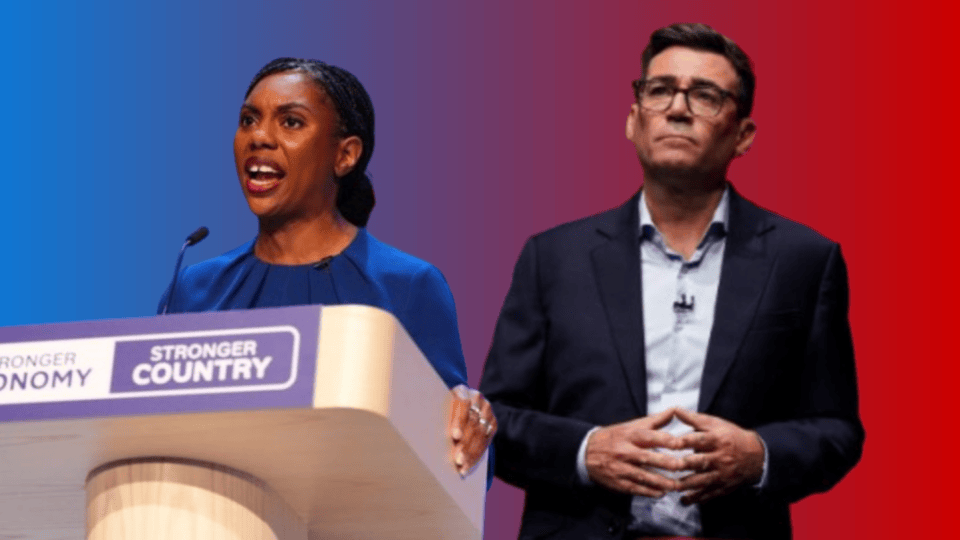
What I am more reluctant in admitting, but nonetheless fear I have to, is that Kemi Badenoch appears to have found her stride. She is morally coherent – if disagreeable – and appears to enjoy her job. She has momentum in the Tory Party, and has taken policy positions popular with its members. She is a good, and improving, public speaker. And she, with Andy Burnham’s help, is increasingly making a cut-through argument as to how the Conservatives will govern differently to Labour. I make no secret of the fact I would never vote Conservative, but I also hope to make no secret of the fact I will at least try to be objective.

There are real arguments now, between Labour and Conservatives, about the size of the state. They were always there, but perhaps less visible and for the wrong reasons. Conservatives have always been for a smaller state, but austerity was argued as from a place of necessity rather than an objectively better way to govern (and paired with, ahem, the triple lock). Boris Johnson’s levelling up agenda was, however you frame it, about wealth distribution. And the 2024 Conservative manifesto was a battle of damage reduction and getting out the core voter base with policies like the quadruple lock and national service rather than a legitimate ideological vision.

This led to the left and the right both seeing different versions of one reality. On the left you have commonplace language such as Red Tories amongst Green supporters, with people disappointed that Keir Starmer didn’t go far enough to distance himself from the Conservative Party. On the right, Reform push the language of the uniparty, trying to make voters believe that there are no legitimate differences between the parties. For a while, this worked.

Now a perfect storm is brewing which is bringing people back to the old red/blue politics for better or for worse. It’s not entirely reflected in the polls yet – and so I do hope my speculation proves correct – but whisper it quietly, I think it will. There is more charisma and divide between Labour and Conservatives, yes. But there is also something else.

The Greens’ conference appears to have been a disaster and for many swing voters, the more they see of Zack Polanski the less they like him. I am certainly in that category, given he is a self-proclaimed populist, and I don’t much care for populists. Its conference was divisive at times with most Green MPs (and Zack Polanski) opposing the “Zionism is racism” motion which was passed by its members, rejecting an internationally- and Palestinian-supported two-state solution. It was uglier at other times, with members rejecting safeguards against disciplining party members for affiliation with Jewish institutions which identify as Zionist.

Left-wing journalist Owen Jones tweeted a phrase which wouldn’t have looked out of place from Rupert Lowe:

There is nothing racist about any ethnic or religious group wanting their own homeland.

He does go on to say that “Zionism in practice meant ‘a homeland at the expense of the Palestinians’,” and that this was why Zionism is racism. Without getting into an in depth essay on Palestinian liberation, this exposes the rifts forming on the left, and the arguments which are perhaps morally murky at times . It also exposes where party democracy can become over-democracy, with members attempting to decide a leader’s policy for them. My interest in the constitution always leads me to believe that a party must decide what is sovereign, and where policy comes from, and seek to not have formal party mechanisms which fundamentally undermine this. In well-established parties, I believe sovereignty should lie with MPs, and democracy should be exercised by members through MPs rather than in spiteof them. This is why Corbyn’s leadership was a disaster regardless of where you sit politically: sovereign MPs being overwritten by party members creates an ungovernable mess. The Greens are at risk of this and it may turn ugly.

Tomorrow is the Holborn and St Pancras by-election. Zack Polanski is on the ballot. It is a liberal, London constituency. It is the seat of the most unpopular Prime Minister in living memory. If Zack Polanski fails to win it, it will be difficult to spin, and it could well spark the end of his charismatic leadership and fresh divides in the Green Party. People do buy into Polanski’s populism – that is why it’s called populism – and it remains to be seen whether another leader could have the same galvanising effect.

On the other side of the aisle chasm, Reform are slowly but surely slipping in the polls. There was once a time – see their repeated success in the polls below – where they looked sure to be the dominant party in votes, even if not in seats, come the next general election. Their messaging was slick, their campaigning was dirty, and they captured people’s anger. The public were shifting to the populist right based on their frustration with the cost of living, immigration, and the undefined woke liberal elite. It was easy to see that people were frustrated with the Conservative and Labour governments and so the natural place for them to go if they leant right was Reform. This was always going to happen – the Conservatives’ record in government was high tax, poor services, not enough prison spaces, and a poor delivery record. To many people, Labour was unappealing and more of the same disappointment.
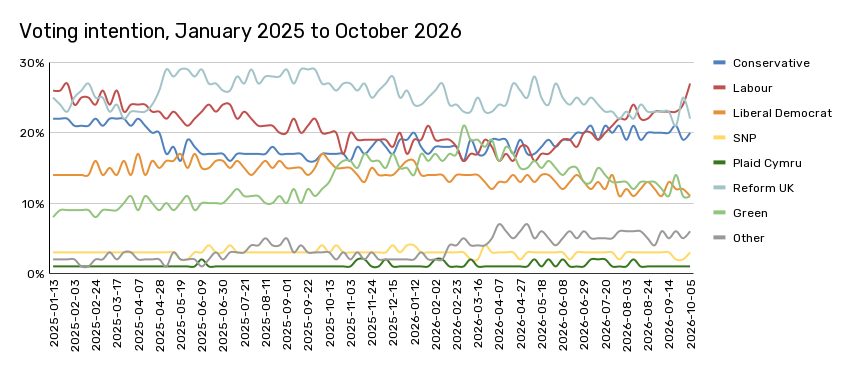
As time has gone on, however, Reform have got dirtier and dirtier. Their image is no longer of that of political outsiders but rather dirty money. They have underperformed in recent by-elections, and their record where they are in power in local government will do them a disservice. As with all populists, they are successful until they have to keep their promises; one Reform council in the north of England has recently received criticism for shutting nurseries. Each promise they have been given a chance to keep has gone poorly. How is finding waste in councils going, Mr Farage?

This dirtying of their image, combined with an obvious change in both the Labour and Conservative parties, might just mean Reform too has peaked. The improving communication of both parties mean that there is now a clearly left wing government and a clearly right wing opposition. The right may be returning to the Conservatives just as the left return to Labour. Kemi Badenoch may have been correct this week when she said a battle of ideas is coming.
Is Andy Burnham Britain’s Mark Carney?

Andy Burnham and Mark Carney share a number of similarities as political heavyweights and recently selected Prime Ministers. Will Burnham’s success follow Carney’s?

Andy Burnham and Mark Carney share a number of similarities as political heavyweights and recently selected Prime Ministers. Both became leader of their parties with overwhelming support and little serious opposition. Neither were longstanding Members of Parliament when elected Prime Minister. Both became leader of left wing governing parties, replacing a deeply unpopular leader. Neither was forecast to perform well at the next election.

Both are good listeners to the extent of disapproving of their Parliamentary party’s own legislation, acting in an almost Presidential fashion. Upon his election, Mark Carney nullified the Liberal government’s previous carbon tax, said yes to new fossil fuel development, and campaigned to address immigration. Upon his election, Andy Burnham removed VAT on electricity bills, has promised to be “pragamtic” on new fossil fuel development, and campaigned to address small boat crossings.

In Canada, the Liberal Party was trailing in the polls until a couple of things became clear. One, there was a change of direction at the top, and a leader who was in touch with the public. Two, foreign policy had a unifying effect on Canadians against a foreign opponent (remarkably, in the United States). Andy Burnham has secured the former, and the latter may come into play with rising tensions in Argentina, increasing threats from Russia, and wider geopolitical recalibration. A “rally round the flag” effect present challenging circumstances for a Prime Minister and few would like to be in that position, but the effect on their polling is undoubtable. Just look at Boris Johnson’s polling during the COVID pandemic.

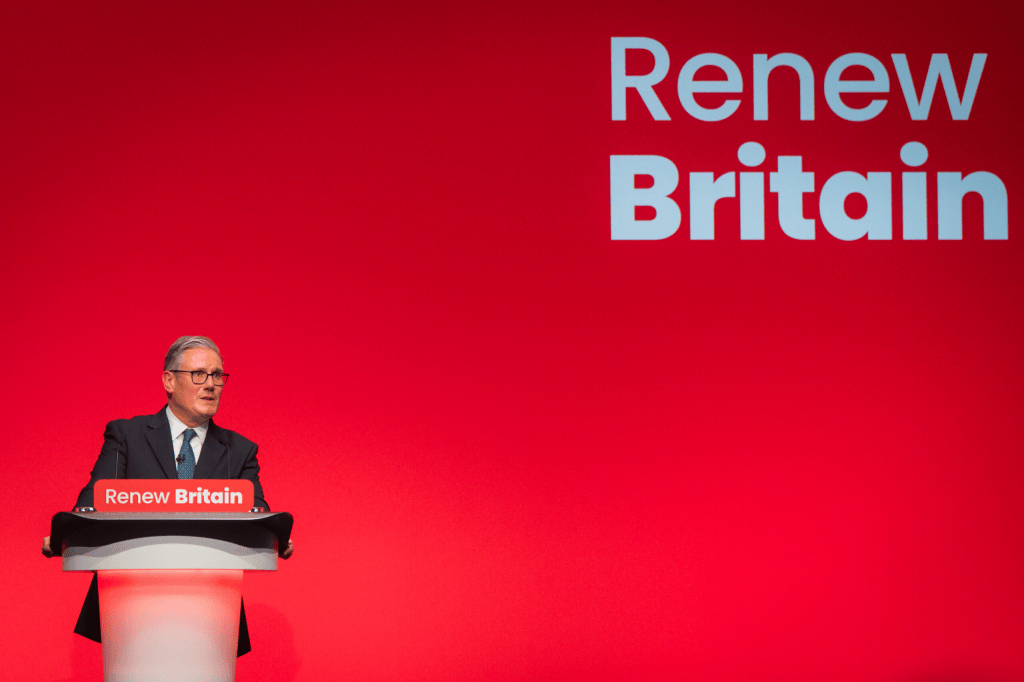
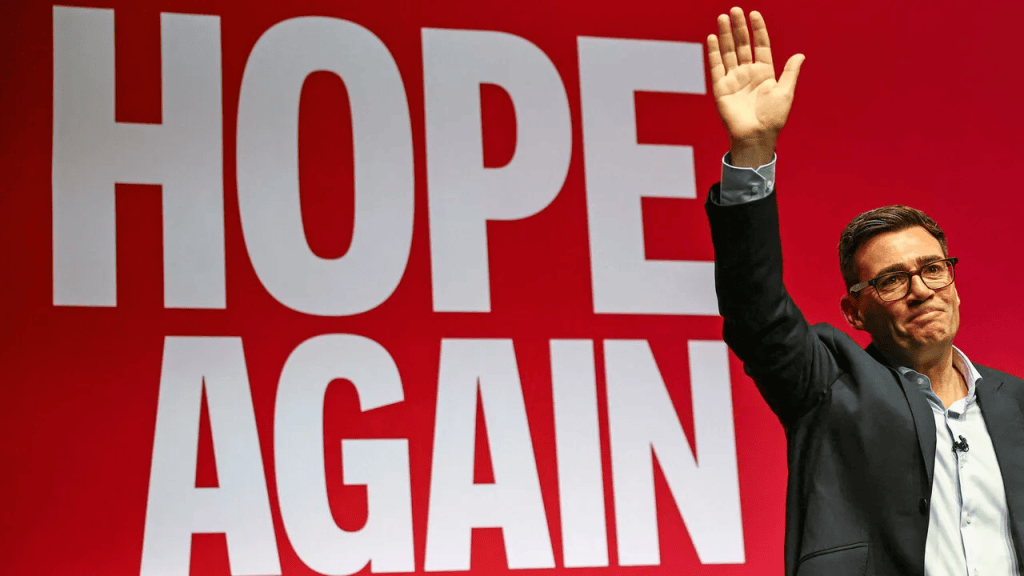
Andy Burnham also has another gift which perhaps aids him further in his quest to replicate Carney’s success in Canada. That is, he is an excellent communicator. There are two pictures below – one of Keir Starmer’s speech to Labour conference in 2025, and another of Andy Burnham’s in 2026. I have chosen images which are perhaps more evocative of my point, but it stands – Keir Starmer was like a politician. He stood behind a podium and lectured. Andy Burnham is not. He engages with people and has a gift of appearing to be on the same level as them.

This is not to say the podium is the mark of a poor leader – it isn’t. Blair and Carney spoke behind one, as did Boris Johnson. But it does demonstrate skill as an orator and an ability to connect with the electorate.

Burnham and Carney share one other thing, and I argue that it is the thing driving the rise of the populist right (and to a lesser extent, the left) across the Western World. This is that the recent years have belonged to, in my eyes, outsiders. Trump, Farage, the AfD, Le Pen, and even Boris Johnson. These are people who have been or styled themselves as outsiders, and who have managed to capture people’s legitimate frustrations and turn them towards their political cause. Left-wing politicians have done the same albeit often less successfully – look at Zack Polanski’s appeal amongst young people by capturing what matters for many young people (although with little serious policy proposals). As Mayor of Greater Manchester, Andy Burnham grew to understood the reasons behind this frustration well, and is therefore well placed to act and speak like an outsider.

Burnham has captured the public mood. The fact his proposals to meet the needs of the people are left-wing don’t, in my eyes, matter to the electorate. It is too easy to fail to remember that most people are not passionately left or right wing, and most people view their own politics as common-sense. When people see good ideas, they tend to like them. Of course there are competing needs between demographics, but knowing what is frustrating people and honestly trying to solve these challenges is a good place to start, and line Andy Burnham up well to emulate Mark Carney’s success.

The breakneck speed of Burnham

I had planned – and mostly written – a blog post on the risks the Labour Party could face in their leadership election process. It would have reflected on Liz Truss and Jeremy Corbyn’s times as leaders of their respective parties, when the position was theirs despite not being the first pick of their Parliamentary parties.

The process of going out to party members would have perhaps been more democratic in that it would reflect the will of such members. The process would have been arguably less democratic and certainly less aligned with the constitution in that the people who must make decisions in Parliament – the MPs – must represent all people, not just party members. They are the ones who, constitutionally, are required to have confidence in the Prime Minister. They are, in my view, the ones whose views matter the most (although not alone given the Labour Party’s rich history of union affiliation and member democracy).

None of this happened in the end and no risk was to be present as Andy Burnham was, as the press says, “coronated” as Prime Minister. I think this is a stretch, but I also don’t think it’s bad. His approach, which he’s described as distinctively Labour, has clearly united the Party, and his comms style – perfected over a decade or so as Mayor of Greater Manchester – has landed well with most audiences.

What is so striking though, is his ability to hit the ground running. Keir Starmer did do this in his first days as Prime Minister but he focused on macro level changes and was quick to deliver bad news.

Statements from Keir Starmer’s first week in office? Important things, but disconnected from people’s everyday lives. Things that make a difference in the long run, yes, but are not things that people will feel here and now:

  • The NHS is broken
  • Home Secretary launches new Border Security Command
  • It’s time to reset Britain’s relations with Europe
  • Chancellor Rachel Reeves is taking immediate action to fix the foundations of our economy
  • Education Secretary begins push to recruit 6,500 new teachers

I’m a Transport Planner, so I’ll also look at the transport commitments:

  • Transport Secretary sets out 5 key priorities to deliver the biggest overhaul to transport in a generation
    • improving performance on the railways and driving forward rail reform
    • improving bus services and growing usage across the country
    • transforming infrastructure to work for the whole country, promoting social mobility and tackling regional inequality
    • delivering greener transport
    • better integrating transport networks.

It will come as no surprise to you that I think these are all outstandingly important and worthwhile interventions. But what can people point at and say “the government did that, and it’s good for me?” This is not to say one is better or more important than the other, but it is to say that one is likely better at winning votes.

What statements have been made during Burnham’s first week in office?

  • New PM says government can bring back hope to Britain, and launches drive to end rough sleeping at earlies opportunity
  • New PM cuts tax on household electricity bills to give breathing space on cost of living
  • Cheaper travel for millions with a third off fares
  • Burnham means business: PM slashes business rates bills for pubs, clubs and live music venues
  • No10 North open for business as the Government’s new situation room for making Britain better

To me, this means a few things. Burnham’s first priority has been on tangible things – rough sleeping, energy bills and bus fares are all things people will notice every day. They’re also things that people can speak about. Perhaps Burnham has had the advantage that no Prime Minister has previously had of being a Metro Mayor. A role that was brand new to him, he delivered a number of highly visible policies which people felt every day. Indeed bus franchising is considerably less visible than the Bee Network, even if they’re exactly the same thing.

Second, even the less tangible things – business rates and Number 10 North – are well thought through and punchy.

B/siness rates are targeted and good news. It may not have been by design but I also think they feel a bit more tangible as, quite simply, people like pubs and venues. The next sentence is stereotypical and hyperbolic but I hope it illustrates my point. Socially conservative voters will like their local traditional pub; socially liberal voters will like their local progressive venues like LGBTQ+ bars; and middle England will welcome this news for wherever they frequent. It probably feels like Burnham is “for us” for all of these groups.

Number 10 North? Okay, yes, this one is less tangible in the difference it will make to everyday people. However, it’s considerably more tangible in the way that it is – somehow – already up and running.

In the conversations I’ve had over the past few weeks, it is clear that Burnham has got political instincts in a way that Starmer did not. He can communicate with people on a way that feels personal. Communication was never a strong point of Keir Starmer’s government – people scarcely knew of the positives delivered – and I am optimistic that this is resolved under Burnham.

The winter fuel allowance is, in my eyes, an excellent example of Keir Starmer’s approach which didn’t serve him well. There are two statements which I believe to be true at the same time. The first is that older people are the wealthiest generation and it is morally and financially wrong for the money of working people to be sent to wealthy people with no homeownership costs. The second is that older people vote at the highest numbers and were not willing to extend good will to Starmer in this instance. This meant that the policy contributed to a collapse in Starmer’s personal approval ratings and did not yield the long-term savings promised as it was, at least partially, reversed. Poor political instincts.

The benefits of Burnham will hopefully be a reversal of Starmer’s flaws, in a way that is dinstinctly Labour. I look forward to seeing what he delivers.