Andy Burnham and Mark Carney share a number of similarities as political heavyweights and recently selected Prime Ministers. Both became leader of their parties with overwhelming support and little serious opposition. Neither were longstanding Members of Parliament when elected Prime Minister. Both became leader of left wing governing parties, replacing a deeply unpopular leader. Neither was forecast to perform well at the next election.
Both are good listeners to the extent of disapproving of their Parliamentary party’s own legislation, acting in an almost Presidential fashion. Upon his election, Mark Carney nullified the Liberal government’s previous carbon tax, said yes to new fossil fuel development, and campaigned to address immigration. Upon his election, Andy Burnham removed VAT on electricity bills, has promised to be “pragamtic” on new fossil fuel development, and campaigned to address small boat crossings.
In Canada, the Liberal Party was trailing in the polls until a couple of things became clear. One, there was a change of direction at the top, and a leader who was in touch with the public. Two, foreign policy had a unifying effect on Canadians against a foreign opponent (remarkably, in the United States). Andy Burnham has secured the former, and the latter may come into play with rising tensions in Argentina, increasing threats from Russia, and wider geopolitical recalibration. A “rally round the flag” effect present challenging circumstances for a Prime Minister and few would like to be in that position, but the effect on their polling is undoubtable. Just look at Boris Johnson’s polling during the COVID pandemic.
Andy Burnham also has another gift which perhaps aids him further in his quest to replicate Carney’s success in Canada. That is, he is an excellent communicator. There are two pictures below – one of Keir Starmer’s speech to Labour conference in 2025, and another of Andy Burnham’s in 2026. I have chosen images which are perhaps more evocative of my point, but it stands – Keir Starmer was like a politician. He stood behind a podium and lectured. Andy Burnham is not. He engages with people and has a gift of appearing to be on the same level as them.
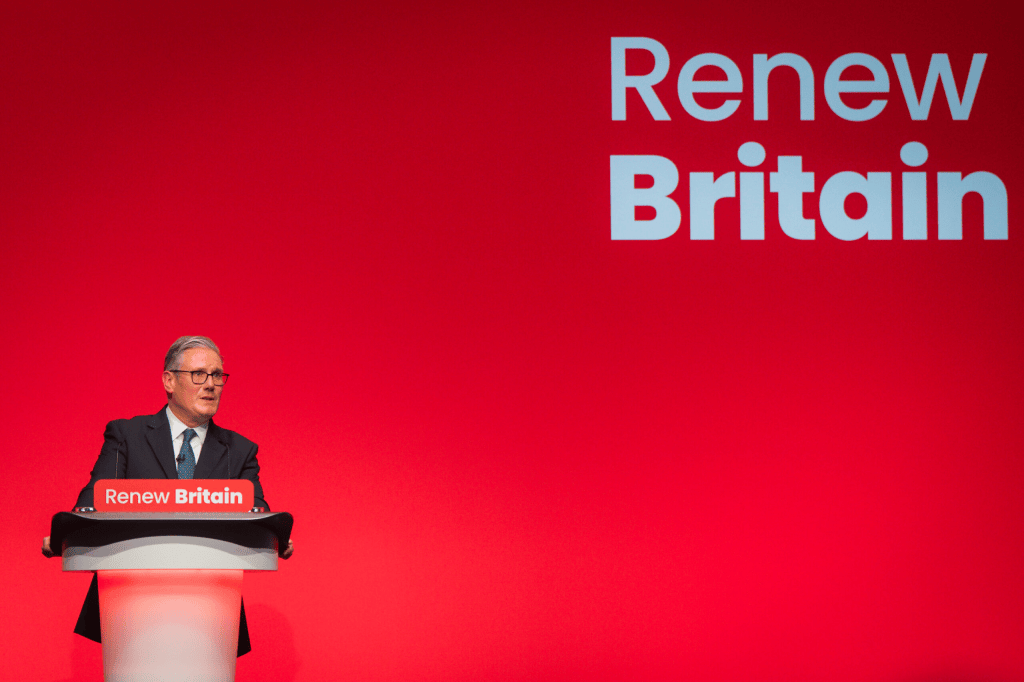
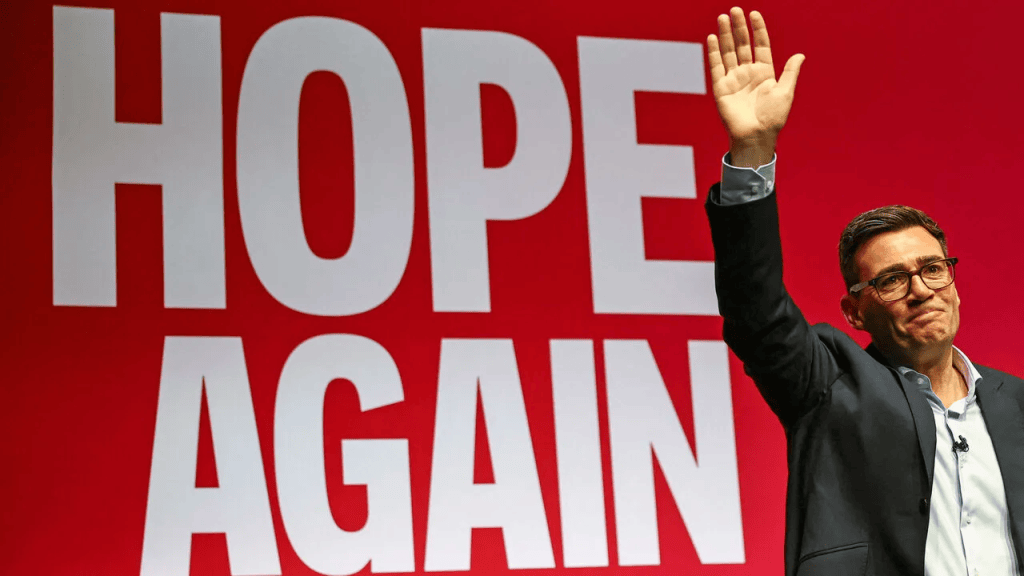
This is not to say the podium is the mark of a poor leader – it isn’t. Blair and Carney spoke behind one, as did Boris Johnson. But it does demonstrate skill as an orator and an ability to connect with the electorate.
Burnham and Carney share one other thing, and I argue that it is the thing driving the rise of the populist right (and to a lesser extent, the left) across the Western World. This is that the recent years have belonged to, in my eyes, outsiders. Trump, Farage, the AfD, Le Pen, and even Boris Johnson. These are people who have been or styled themselves as outsiders, and who have managed to capture people’s legitimate frustrations and turn them towards their political cause. Left-wing politicians have done the same albeit often less successfully – look at Zack Polanski’s appeal amongst young people by capturing what matters for many young people (although with little serious policy proposals). As Mayor of Greater Manchester, Andy Burnham grew to understood the reasons behind this frustration well, and is therefore well placed to act and speak like an outsider.
Burnham has captured the public mood. The fact his proposals to meet the needs of the people are left-wing don’t, in my eyes, matter to the electorate. It is too easy to fail to remember that most people are not passionately left or right wing, and most people view their own politics as common-sense. When people see good ideas, they tend to like them. Of course there are competing needs between demographics, but knowing what is frustrating people and honestly trying to solve these challenges is a good place to start, and line Andy Burnham up well to emulate Mark Carney’s success.

